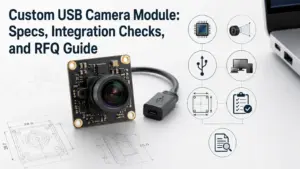
Choosing an OV7725 camera module manufacturer is not just a matter of finding a page that lists the OV7725 sensor.
For engineering and procurement teams, the bigger question is whether the finished module fits the host system, image requirements, mechanical design, cable route, software environment, and supply plan. A sensor name can start the conversation, but it does not confirm the full module design.
This guide explains what to check before you request a quote, compare suppliers, or approve an OV7725 camera module for sampling.
What to Check Before Choosing an OV7725 Camera Module Manufacturer
When choosing an OV7725 camera module manufacturer, confirm the finished module specifications, not only the sensor model. Check resolution, frame rate, interface, output format, lens and field of view, PCB size, connector, cable, UVC or OS support, lifecycle status, available documents, and customization questions before requesting a quotation.
OV7725 Sensor vs. Finished Camera Module
The OV7725 is listed by OMNIVISION as a 1/4-inch VGA image sensor with a 640 × 480 image array. The same OMNIVISION page describes VGA operation up to 60 fps at the sensor level and lists SCCB plus output format support such as RAW RGB, RGB, and YCbCr. It also currently marks OV7725 as “End-of-Life” and “Not available.” OV7725 product page
That matters because a finished camera module is more than the sensor. It can include a PCB, lens, connector, cable, USB bridge, firmware, UVC behavior, mechanical layout, and test requirements. A sensor-level data point does not automatically prove what a USB camera module will deliver in your system.
| Item | Sensor-level question | Finished-module question | Why it matters |
|---|---|---|---|
| Resolution | What image array does the sensor support? | What resolution does the module output through the selected interface? | Avoid assuming every module exposes the same output. |
| Frame rate | What does the sensor page list? | What frame rate is listed for the actual module and test condition? | USB bridge, firmware, and format may affect the result. |
| Interface | What sensor control/output interfaces exist? | Is the finished module USB2.0, MIPI, DVP, or another interface? | Host compatibility depends on the module interface. |
| Output format | What formats are supported at sensor level? | What formats does the finished module provide? | Software integration often depends on output format. |
| Lens/FOV | Not defined by sensor alone. | What lens and field of view are assembled? | Image coverage depends on optical design. |
| Connector/cable | Not defined by sensor alone. | What connector and cable length are supplied? | Mechanical integration can fail even when electronics fit. |
| Lifecycle | Is the sensor active, EOL, or hard to source? | Can the supplier confirm module availability or alternatives? | Important for replacement, repeat orders, and new designs. |

A good supplier discussion should therefore separate “OV7725 sensor capability” from “this specific module’s tested configuration.”
Key Specs to Confirm Before You Compare Suppliers
Before you compare OV7725 camera module manufacturers, prepare a short list of the module-level details your team needs confirmed. This helps avoid a common sourcing problem: two suppliers may both say “OV7725 camera module,” but the delivered modules may differ in interface, lens, board size, connector, firmware, and supported host systems.
For example, Supertek’s ST-OV7725 datasheet lists a USB2.0 camera module with a 1/4-inch OV7725 sensor, 640H × 480V resolution, MJPG/YUV2 output, default 120-degree field of view, fixed focus, UVC compliant plug-and-play connection, 5-pin 1.25 mm connector, 30 fps at VGA, default 1 m USB cable, and 30 × 25 mm module size. ST-OV7725 datasheet
Use those values as an example of what a product page or datasheet should clarify. Do not assume the same values apply to every OV7725 module.
| Spec to confirm | Why it matters | Example of safe RFQ wording |
|---|---|---|
| Sensor model | Confirms the imaging component being discussed. | Please confirm whether the module uses OV7725. |
| Resolution | Confirms the output expected by the host system. | We need VGA 640 × 480 output. Please confirm actual module output. |
| Interface | Determines hardware compatibility. | Our host requires USB2.0. Please confirm interface and connector. |
| Output format | Affects software, bandwidth, and image handling. | Please confirm MJPG, YUV2, or other supported formats. |
| Frame rate | Must be checked under actual module conditions. | Please state the tested frame rate at VGA and the test conditions. |
| Lens/FOV | Changes image coverage and working distance. | We need approximately [FOV] at [working distance]. Please recommend lens options. |
| PCB size | Must fit enclosure and mounting. | Please confirm board dimensions and mounting-hole position. |
| Connector/cable | Affects assembly and reliability. | Please confirm connector type, cable length, and cable direction. |
| UVC/OS support | Reduces driver risk for USB projects. | Please confirm UVC behavior and supported operating systems. |
| Lifecycle | Important for repeat orders or long programs. | Please confirm current availability and any recommended alternatives. |
Manufacturer Selection Checklist for OV7725 Camera Modules
A practical manufacturer comparison should look beyond the lowest price. For an OV7725 project, the supplier’s response quality can be as important as the listed product.
| Selection point | What to ask | Why it matters |
|---|---|---|
| Product clarity | Can the supplier provide a datasheet, drawing, or product page for the exact module? | Reduces confusion between similar OV7725 listings. |
| Engineering response | Can they explain interface, lens, format, OS, and mechanical constraints? | Helps your team identify integration risk early. |
| Module-level testing | Can they state how listed frame rate and output format were tested? | Prevents sensor-level assumptions from becoming design problems. |
| Customization discussion | Can they review lens, cable, connector, PCB, or firmware needs? | Useful for OEM projects, but should be confirmed case by case. |
| Lifecycle support | Can they confirm availability, stock, or alternatives? | Important because OV7725 is currently shown as End-of-Life on OMNIVISION’s page. |
| Documentation | Can they provide datasheet, dimensions, image sample, or test information? | Helps engineers approve the module faster. |
| RFQ discipline | Do they ask for application conditions before quoting? | A better RFQ process can prevent wrong module selection. |
Avoid choosing based only on a product title. A clear manufacturer discussion should help your team decide whether the listed module is ready to test, needs adjustment, or should be replaced by another sensor/module option.
Check Lifecycle, Availability, and Alternatives
The OV7725 is an older VGA sensor topic. OMNIVISION currently labels OV7725 as End-of-Life and Not available on its product page. OV7725 product page
That does not automatically mean no finished modules exist, but it does mean buyers should ask direct lifecycle questions before designing it into a new project.
| Question | Why to ask |
|---|---|
| Is the exact OV7725 module available now? | Confirms whether the product is still orderable. |
| Is the module suitable for new design or mainly replacement/legacy use? | Helps avoid lifecycle risk in a long project. |
| Is there available stock or a forecast for repeat orders? | Important for procurement planning. |
| Is there a recommended alternative if OV7725 supply changes? | Gives engineering a backup path. |
| Does the alternative require lens, firmware, housing, or software changes? | Prevents surprise redesign work. |
Use careful wording here. The right conclusion depends on the supplier’s stock, design history, and available alternatives.
Is an OV7725 Camera Module Right for Your Application?
OV7725 modules are usually discussed for VGA-level imaging needs. Whether that is enough depends on the project.
A 640 × 480 camera may be reasonable for basic embedded vision, legacy replacement, simple inspection, or low-resolution USB imaging. It may not be enough for applications that need high detail, strong low-light performance, long lifecycle support, or modern high-resolution image processing.
| Application situation | Why OV7725 may be considered | What to verify first |
|---|---|---|
| Legacy product replacement | Existing design may already use OV7725 or VGA output. | Mechanical fit, connector, cable, output format, and availability. |
| Embedded device prototype | VGA may be enough for simple visual feedback. | Host interface, driver/UVC support, lens, and lighting. |
| Kiosk or basic terminal | Simple image capture may not require high resolution. | Enclosure, field of view, cable route, OS support, and lifecycle. |
| Inspection tester | VGA may work for low-detail positioning or presence checks. | Working distance, lens, lighting, frame rate, and image quality. |
| Video conference prototype | USB/UVC module may simplify testing. | Actual frame rate, exposure, lens, OS, and image expectations. |
| New long-life product | OV7725 may create lifecycle questions. | Sensor availability, supplier stock, and newer alternatives. |

Do not treat OV7725 as universally suitable. The right module depends on the image task, environment, host system, and supply plan.
What to Include in an OV7725 Camera Module RFQ
A clear RFQ helps the supplier check technical fit before quoting or recommending a sample. It also helps your internal engineering and procurement teams avoid repeated clarification emails.
Include these details when contacting an OV7725 camera module manufacturer:
| RFQ item | What to send |
|---|---|
| Application | What the camera needs to capture and where it will be installed. |
| Host system | Main board, processor, operating system, and software environment. |
| Interface | USB2.0, DVP, MIPI, or another required interface. |
| Resolution and frame rate | Required output resolution and expected frame rate. |
| Output format | MJPG, YUV2, RAW, RGB, or another required format. |
| Lens/FOV | Desired field of view, working distance, focus type, and lens limits. |
| Mechanical limits | PCB size, mounting holes, enclosure space, and orientation. |
| Cable/connector | Connector type, cable length, cable direction, and shielding needs. |
| Environment | Temperature, lighting, vibration, dust, or enclosure concerns. |
| Quantity and stage | Prototype, sample, pilot, or mass production estimate. |
| Documents | Datasheet, drawing, test information, image samples, or certificates if available. |
| Lifecycle question | Whether OV7725 is available or whether an alternative is recommended. |

Keep commercial questions separate from technical fit. Price, MOQ, lead time, and warranty should be confirmed directly by the supplier for the actual project and should not be assumed from a general article.
Example: How to Review Supertek’s Listed OV7725 USB2.0 Module
A product page can be useful if you read it as a starting point, not a complete project approval.
Supertek’s OV7725 product page lists an ST-OV7725 USB2.0 camera module with OV7725 sensor, 5V USB2.0 interface, and 640H × 480V resolution. The page also describes the module as USB2.0 compliant, plug and play, rolling shutter, and customizable. Supertek OV7725 product page
The datasheet gives more module-level details, including MJPG/YUV2 output, default 120-degree field of view, fixed focus, UVC compliant plug-and-play connection, 5-pin 1.25 mm connector, 30 fps at VGA, default 1 m USB cable, and 30 × 25 mm module size. ST-OV7725 datasheet
For a real project, review those details against your own requirements:
| Listed item | What to compare against your project |
|---|---|
| USB2.0 interface | Does your host board support USB2.0 camera input? |
| 640H × 480V resolution | Is VGA enough for your image task? |
| MJPG/YUV2 output | Does your software support the listed formats? |
| Default 120° field of view | Does the lens cover the required scene without distortion problems? |
| UVC compliant | Does your OS or application handle UVC as expected? |
| 30 fps at VGA | Is this enough under your expected format and lighting conditions? |
| 30 × 25 mm module size | Does the PCB fit your enclosure and mounting layout? |
| Connector and cable | Does the connector or cable fit your assembly process? |
If your project needs a different lens, cable, connector, PCB shape, or host behavior, ask the supplier to review feasibility instead of assuming it can be changed.
FAQ
Is an OV7725 sensor the same as an OV7725 camera module?
No. The sensor is only one part of the finished camera module. A finished module may also include a PCB, lens, connector, cable, interface bridge, firmware, and test configuration. Always confirm the finished module specification before ordering.
Does every OV7725 module support the same frame rate?
No. OMNIVISION lists sensor-level VGA operation up to 60 fps, but a finished module may list a different frame rate depending on interface, firmware, output format, and test conditions. For example, Supertek’s ST-OV7725 datasheet lists 30 fps at VGA for that module.
What specs should I confirm before requesting a quote?
Confirm sensor model, resolution, frame rate, interface, output format, lens, field of view, focus type, PCB size, connector, cable length, UVC or OS support, operating environment, quantity, documents, and lifecycle status.
Can an OV7725 camera module be customized?
It depends on the supplier and project requirements. Ask whether lens, field of view, cable, connector, PCB layout, firmware behavior, or other details can be reviewed for your application. Do not assume every listed module can be changed without validation.
Is OV7725 suitable for new product development?
It may be suitable for some projects, especially where VGA resolution and existing design compatibility matter. However, because OMNIVISION currently marks OV7725 as End-of-Life and Not available, new designs should confirm supply, lifecycle risk, and possible alternatives before committing.
What should procurement ask the manufacturer?
Procurement should ask for the exact module datasheet, drawing, tested output format and frame rate, connector and cable details, available documents, lifecycle status, sample process, quotation terms, and whether any alternative modules are recommended.
Should I choose a supplier based on price first?
Price matters, but it should not be the only filter. For camera modules, a low price is not useful if the interface, lens, cable, software support, or lifecycle does not fit the project.
Next Step: Send Your Requirements for Technical Review
Before choosing an OV7725 camera module manufacturer, prepare your application and technical requirements.
Send the supplier your host system, interface, resolution and frame-rate target, lens and field-of-view needs, PCB size limits, connector and cable requirements, output format, OS/UVC needs, quantity estimate, lifecycle concerns, and document requests.
For Supertek’s listed ST-OV7725 USB2.0 module, use the product page and datasheet as a starting point, then ask the team to confirm whether the listed configuration fits your project or whether another module should be reviewed.