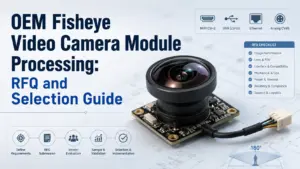
OEM fisheye video camera module processing starts with a practical question: what does the supplier need to know before reviewing your project?
A fisheye camera module is not selected by viewing angle alone. For an OEM device, the module also has to match the enclosure, host platform, interface, connector, cable route, resolution target, frame-rate need, and validation plan.
This guide helps OEM buyers, engineers, procurement teams, and integrators prepare a clear inquiry for fisheye video camera module review.
What should you prepare before OEM fisheye module review?
Before requesting OEM fisheye video camera module processing, prepare your application, target FOV, resolution, frame rate, interface, host platform, board size, lens height, connector and cable needs, working environment, quantity stage, and required documents. These details help the supplier review whether an existing module, a modification, or a custom discussion is appropriate.
What OEM fisheye video camera module processing usually involves
For OEM projects, “processing” does not always mean building a completely new camera module from the beginning. In many cases, the first step is a technical review of the project requirements.
Depending on the application and feasibility review, the discussion may involve:
- checking whether an existing fisheye module is suitable;
- reviewing lens angle, sensor, image output, and interface needs;
- checking PCB size, lens height, connector, and cable constraints;
- discussing whether modification or custom development is needed;
- confirming sample, document, and production questions after requirements are clear.
The safe way to begin is to describe the device, not just the camera. For customization context, see Supertek’s camera module customization page.
RFQ checklist for a fisheye camera module project
A clear RFQ helps the technical team review your request with fewer assumptions. Use the checklist below before sending an inquiry through the Supertek contact page.
| RFQ Item | What to Prepare | Why It Matters |
|---|---|---|
| Application | Security device, robot, smart device, inspection device, access control, or other use case | Application affects FOV, enclosure, interface, and validation needs. |
| Target FOV | Approximate horizontal, vertical, or diagonal field of view | Fisheye selection depends on viewing coverage and acceptable distortion. |
| Resolution | Required image or video resolution | Resolution affects sensor choice, bandwidth, and image detail. |
| Frame rate | Target fps at the required resolution | Frame rate affects interface, host processing, and image output requirements. |
| Interface | USB, MIPI, or another required interface | Interface affects host compatibility, connector design, and software integration. |
| Host platform | Main board, processor, OS, driver environment, or video input system | A module must be checked against the actual host, not only the camera specs. |
| Mechanical limits | Board size, lens height, mounting position, enclosure opening | Physical limits can decide whether a module fits the product. |
| Connector and cable | Connector type, cable length, cable route, orientation | Cable and connector choices affect assembly and integration. |
| Working environment | Indoor/outdoor use, lighting condition, temperature concern, vibration concern | Environment affects lens, image tuning, housing, and validation questions. |
| Quantity stage | Prototype, sample review, pilot run, or production planning | The supplier can respond better when the project stage is clear. |
| Document needs | Datasheet, drawing, interface note, sample test information, certificate request if applicable | Document availability should be confirmed for the specific project. |
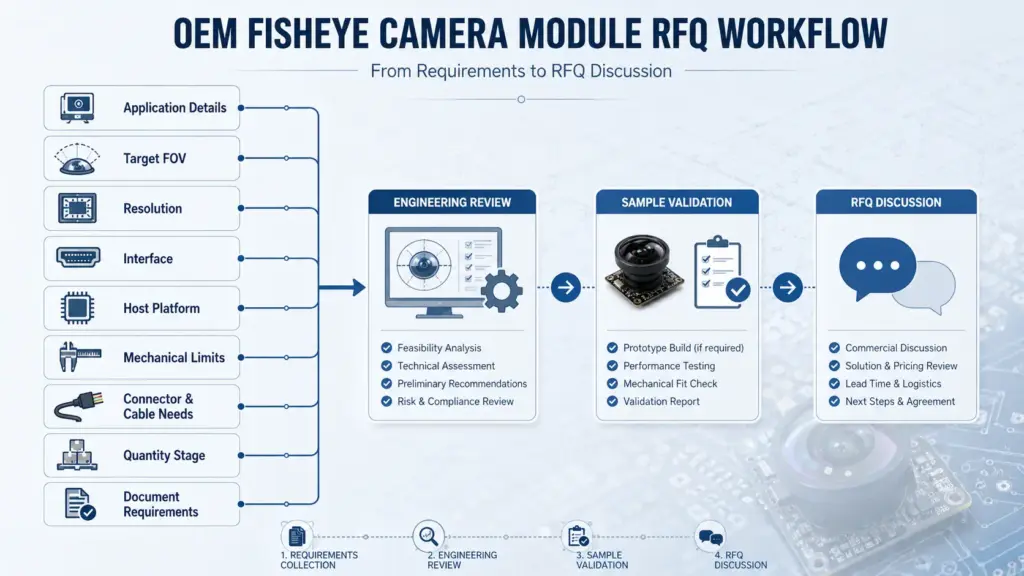
Do not treat the first RFQ as a purchase order. Treat it as a requirements package for technical review.
Ready module, modification, or custom processing: which path fits?
Not every fisheye camera project needs the same level of work. Some buyers may only need a ready module review. Others may need a small change. Some projects may require a deeper custom discussion.
| Path | When It May Fit | What to Prepare | Boundary |
|---|---|---|---|
| Existing module review | Your requirements are close to available fisheye module options | Application, FOV, resolution, interface, host, mechanical limits | Fit still needs confirmation. |
| Minor modification discussion | The basic module fits, but one part needs adjustment | Lens angle, connector, cable length, mounting, output format, or mechanical request | Feasibility depends on review. |
| Custom processing discussion | The product has special optical, electrical, mechanical, or software constraints | Full requirements, drawings if available, host details, sample target, quantity stage | Do not assume all requests are feasible. |
| Procurement confirmation | You need quotation, sample, documents, MOQ, lead time, or packaging details | Quantity, project stage, required documents, destination or commercial terms | Commercial terms must be confirmed case by case. |
This table should not be used to promise that every path is available for every project. It is a way to prepare the right discussion.
FOV is not the only selection factor
Many buyers start with a simple request such as “I need a 180-degree fisheye camera module.” That is a useful starting point, but it is not enough for OEM selection.
A wider FOV can increase scene coverage, but it can also create distortion, reduce edge detail, or require more processing from the host system. The lens, sensor, module size, enclosure opening, and software pipeline all affect the result. For general technical background on lens selection factors such as FOV and distortion, see this embedded camera lens selection guide. You can also review Supertek’s fisheye camera module page for related module context.
| Factor | What to Check | Decision Impact |
|---|---|---|
| FOV | Required viewing coverage and camera position | Determines how much of the scene the module should capture. |
| Distortion tolerance | Whether edge distortion is acceptable for the application | Some applications can accept fisheye distortion; others need correction. |
| Sensor match | Sensor size, resolution, sensitivity, and output needs | Lens and sensor must work together for the target result. |
| Edge detail | Whether image detail near the edge matters | Wider angles may require careful review of useful image area. |
| Lens height | Available space above the PCB or enclosure surface | A fisheye lens may have height or clearance constraints. |
| Board size | Maximum PCB dimensions and mounting method | Limits module options and connector placement. |
| Host processing | Whether the host can handle video format, frame rate, or correction needs | A module that works electrically may still need software validation. |
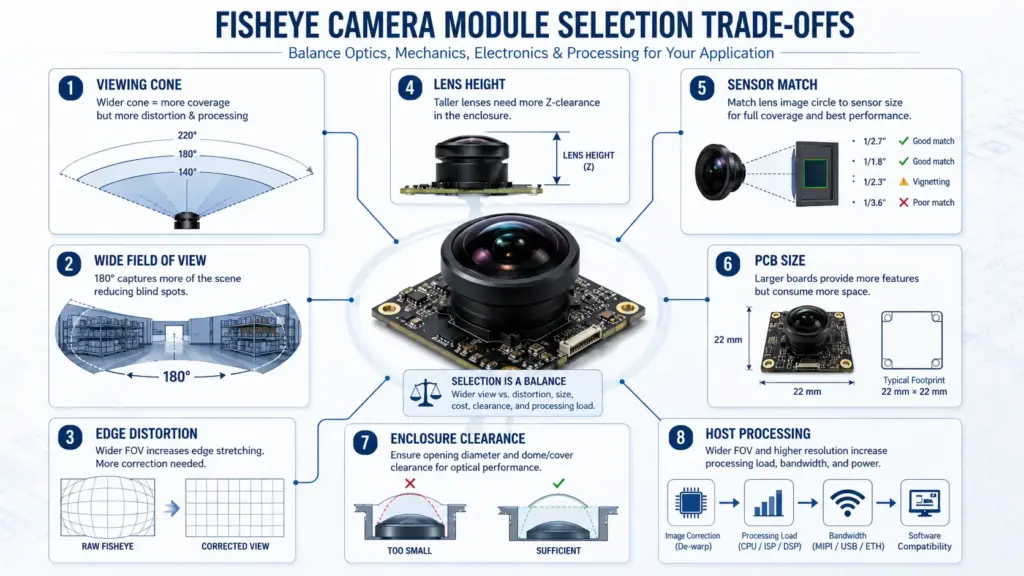
The practical question is not “which FOV is highest?” The better question is: which FOV gives enough coverage while still fitting the enclosure, host system, and image-use requirement?
Interface and host compatibility checks
Interface choice can change the whole project. A camera module cannot be reviewed only by lens angle and resolution. The host system must be able to receive, process, and validate the video signal.
| Compatibility Item | What to Confirm | Why It Matters |
|---|---|---|
| Interface type | USB, MIPI, or another required signal path | Determines electrical and software integration path. |
| Connector | Connector model, pin direction, pitch, or board-side limitation | A wrong connector can block physical integration. |
| Cable | Cable length, route, shielding need, and assembly direction | Cable design affects installation and signal reliability. |
| Output format | Video format or image data requirement | Host software must support the output. |
| Host platform | Processor, main board, OS, or SDK environment | Compatibility depends on the real host environment. |
| Driver need | UVC, custom driver, or platform-specific requirement | Driver assumptions can delay integration. |
| Resolution and frame rate together | Required fps at the target resolution | Bandwidth and host processing must be checked together. |
| Validation method | How the sample will be tested in the final device | Compatibility should be tested in the real application where possible. |
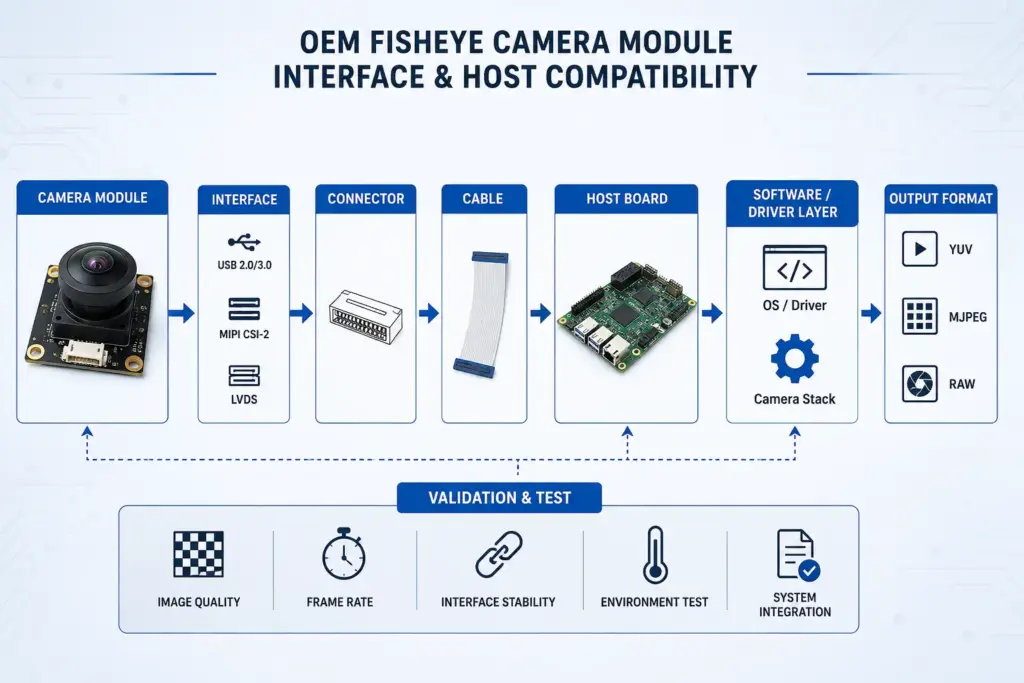
A safe RFQ should not say only “USB camera” or “MIPI fisheye module.” It should explain the host system, connector, cable, and expected output.
Mechanical and optical constraints to confirm early
Mechanical limits are easy to overlook during early sourcing, but they often decide whether a fisheye module can be used.
- maximum PCB size;
- lens height limit;
- enclosure opening size;
- camera mounting position;
- distance between lens and cover glass;
- connector position;
- cable bending direction;
- screw hole or mounting requirement;
- need for housing or bracket;
- lighting condition around the lens.
Optical and mechanical requirements should be reviewed together. A sample may work on a test bench but still need validation inside the final product.
Procurement questions to confirm before sampling or production
Procurement teams often need commercial and document details before moving forward. These questions are important, but they should be handled carefully because they are usually project-specific.
| Procurement Question | Safe Way to Ask |
|---|---|
| MOQ | “What MOQ applies to this specification and project stage?” |
| Lead time | “What sample and production schedule can be confirmed after technical review?” |
| Documents | “Which datasheets, drawings, interface notes, or sample documents are available for this project?” |
| Certificates | “Are any certificates or compliance documents available for this specific module or order?” |
| Warranty | “What warranty terms apply to this product and order condition?” |
| Packaging | “What packaging options are available for samples and production?” |
| Revision control | “How are module changes, drawings, or sample revisions managed?” |
| Payment and delivery | “What commercial terms apply after specification confirmation?” |
Avoid assuming that a certificate, test report, fixed lead time, fixed MOQ, or warranty term applies before the project is reviewed.
What to validate before moving from sample to production
A fisheye camera module should be validated in the real device, not only as a standalone sample. Before moving from sample approval to production planning, check the following items.
| Validation Area | What to Check |
|---|---|
| Image coverage | Does the real installation position capture the required area? |
| Distortion acceptance | Is the fisheye effect acceptable for the application? |
| Edge detail | Is useful detail visible where the application needs it? |
| Interface behavior | Does the module output correctly on the target host? |
| Frame rate and resolution | Does the host handle the required setting reliably? |
| Mechanical fit | Does the PCB, lens height, connector, and cable fit the enclosure? |
| Cable routing | Can the cable be assembled without stress or interference? |
| Lighting condition | Does the image remain acceptable under expected lighting? |
| Software integration | Does the driver, format, and application software work as expected? |
| Production documents | Are drawings, revision details, and procurement requirements clear? |
Sample approval should be based on the final use condition as much as possible.
FAQ
What information should I send for OEM fisheye camera module processing?
Send your application, target FOV, resolution, frame rate, interface, host platform, board size, lens height, connector and cable needs, working environment, quantity stage, and required documents. Drawings, photos, or reference samples can also help if they are available.
Is a fisheye camera module always better than a normal wide-angle module?
No. A fisheye module can provide a very wide viewing area, but it also introduces distortion and may require careful review of edge detail, lens height, enclosure fit, host processing, and application needs. The right choice depends on the device and use case.
Should I choose a ready fisheye module or request custom processing?
Start by checking whether an existing module can meet your key requirements. If the module is close but not exact, a modification discussion may be useful. If the product has special optical, electrical, mechanical, or software constraints, a custom processing discussion may be needed after feasibility review.
Which specs matter most for a fisheye video camera module?
The most important specs usually include FOV, resolution, frame rate, sensor and lens match, interface, output format, board size, lens height, connector, cable, host platform, and working environment. The priority depends on the application.
How do USB, MIPI, or other interfaces affect module selection?
The interface affects electrical connection, cable design, host compatibility, driver needs, video format, frame rate, and validation work. The interface should be reviewed with the host platform and software environment, not as a standalone spec.
What documents should I ask for before sample approval or production?
Ask what documents are available for the project, such as datasheets, drawings, interface notes, sample information, packaging details, revision details, and certificates if applicable. Do not assume every document or certificate is available before confirmation.
What should be validated before moving from sample to production?
Validate image coverage, distortion acceptance, edge detail, interface behavior, frame rate, host compatibility, mechanical fit, cable routing, lighting condition, software integration, and document readiness. Testing should be done in the final device condition when possible.
Send your OEM fisheye camera module requirements for review
To start an OEM fisheye camera module review, prepare your application details, target FOV, resolution, frame rate, interface, host platform, board and mechanical limits, connector and cable needs, quantity stage, and document requirements.
Send your project details to Supertek so the team can review whether an existing module, modification discussion, or custom processing discussion is appropriate for your project.