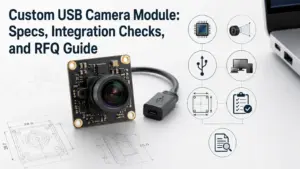
Choosing a camera module PCB manufacturer is not only a sourcing task. It is also an engineering and project-scope decision.
Before asking for a quotation, your team should be clear about what you actually need: a bare PCB supplier, a PCB assembly partner, an FPC or rigid-flex PCB supplier, or a full camera module manufacturing partner. Each option can involve different documents, validation steps, cost drivers, timelines, and technical risks.
This guide is written for OEM buyers, engineers, procurement teams, and product teams preparing to contact a supplier. It explains how to evaluate supplier scope, what technical details affect camera module PCB integration, what to prepare before RFQ, and what evidence to request before relying on supplier claims.
What should you check first?
When evaluating a camera module PCB manufacturer, check four things first: supplier scope, technical fit, RFQ readiness, and evidence. Confirm whether you need bare PCB fabrication, PCB assembly, FPC/rigid-flex support, or full camera module manufacturing. Then prepare the application, interface, dimensions, connector/FPC needs, drawings or samples, quantity range, and document requirements before asking for price or lead time.
Which type of camera module PCB supplier do you need?
“Camera module PCB manufacturer” can mean several different things. One supplier may focus on bare PCB production. Another may provide PCB assembly. Another may specialize in FPC or rigid-flex structures for compact modules. A full camera module manufacturer may discuss PCB, sensor, lens, connector, cable, housing, assembly, and validation as part of a larger module project.
The right choice depends on your project stage and what your team already has.
If your engineering team already has Gerber files and only needs board production, a bare PCB supplier may be enough. If the board also needs components mounted and inspected, you may need PCBA support. If the camera module must fit into a compact enclosure or connect through a flexible tail, FPC or rigid-flex review may be important. If your team needs help with the complete module, including sensor, lens, mechanical fit, cable, and project validation discussion, a full camera module manufacturing partner may be more relevant.
Supplier-type decision table
| Project need | Likely supplier type | What to prepare | What to verify |
|---|---|---|---|
| Bare camera PCB only | PCB fabrication supplier | Gerber files, stack-up needs, board dimensions, material expectations, finish requirement if known | Fabrication capability, stack-up review, inspection method, document availability |
| Assembled camera PCB | PCBA or electronics assembly partner | Gerber, BOM, pick-and-place data if available, component requirements, sample quantity | Assembly process, inspection/testing approach, component sourcing boundaries |
| Compact module interconnect | FPC or rigid-flex PCB supplier | Mechanical drawings, bend/fold area, connector position, thickness constraints, enclosure limits | Flexible PCB experience, stack-up review, mechanical validation expectations |
| Camera PCB plus module integration | Camera module manufacturing partner | Sensor/module target, lens/FOV needs, interface, dimensions, cable/FPC, housing or mounting requirements | Module review process, sample validation path, document scope, communication flow |
| Early-stage custom project | Engineering-oriented manufacturing partner | Application, performance goal, known constraints, available samples, target quantity range | Whether the supplier can review scope before quote without making unsupported promises |
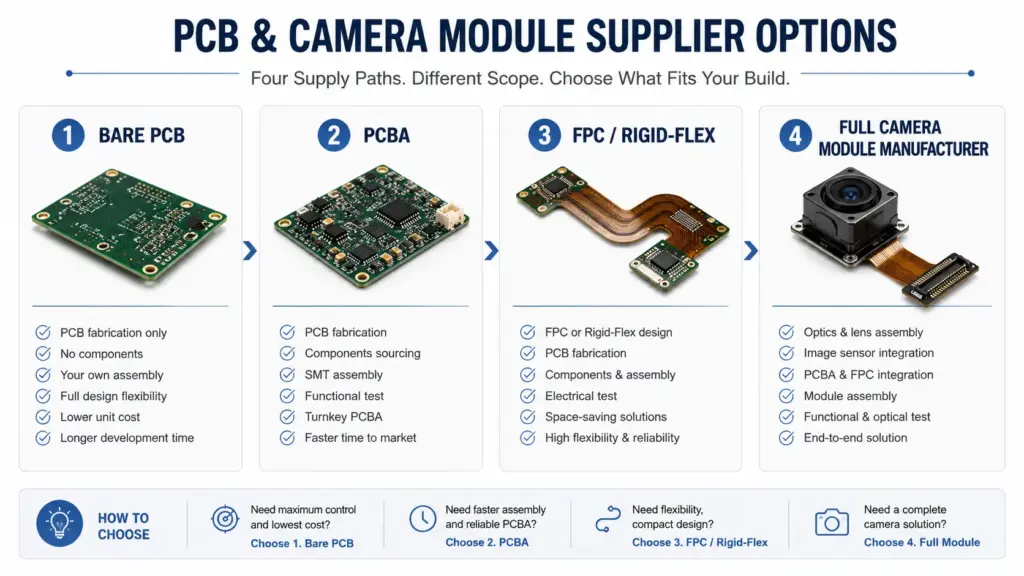
This table is not a ranking. A bare PCB supplier is not automatically worse than a full module manufacturer. It simply serves a different project need. Choosing the wrong supplier type often causes RFQ delays because the supplier must ask for missing information or redirect the project scope.
Technical details that affect camera module PCB integration
A camera module PCB has to support more than component placement. It may affect signal routing, connector layout, module size, power behavior, thermal conditions, mechanical fit, and sample validation.
For early supplier discussions, the most useful question is not “Can you make this?” It is “What information does the supplier need to review this project properly?”
Important details usually include the camera interface, board or module dimensions, sensor or module target, connector or FPC layout, power requirements, environment, and validation needs. For high-speed interfaces, the PCB stack-up, routing, impedance control, grounding, shielding, and connector choices may affect the review. For compact products, the board shape, FPC bend area, lens position, and enclosure constraints may matter just as much as the electrical design.
Integration-risk table
| Factor | Why it matters | What to ask the supplier | Evidence or validation needed |
|---|---|---|---|
| Interface type | Interfaces such as MIPI, LVDS, USB, DVP, GMSL, or FPD-Link may have different layout and validation concerns. | What design files or interface details are needed for review? | Stack-up review, routing review, sample test plan where applicable |
| Board or module size | Compact modules can create layout, thermal, and connector-placement trade-offs. | Can the supplier review the mechanical constraints before quotation? | Drawing review, enclosure or mounting reference, sample discussion |
| Sensor and lens position | Optical alignment and mechanical fit may affect module performance and assembly discussion. | What sensor, lens, focus, FOV, or mounting information should be provided? | Sample validation plan and acceptance criteria |
| Connector, cable, FPC, or rigid-flex need | The interconnect affects assembly, bending, space, and durability discussion. | Does the project require FPC, cable, board-to-board connector, or rigid-flex review? | Mechanical drawing, bend area, connector specification, sample test plan |
| Power, noise, and EMI concerns | Camera modules may be sensitive to power quality, routing, grounding, and nearby noise sources. | What operating conditions or layout constraints should engineering share? | Design review notes, test conditions, application environment |
| Thermal and enclosure conditions | Heat, enclosure space, and mounting location can affect long-term behavior. | What temperature range, enclosure, or duty-cycle information is needed? | Application condition review and sample validation |
| Target market and documents | Some products require specific certificates, reports, or compliance documents. | Which documents are available or required for this project and market? | Certificate scope, test report scope, or client-provided requirement list |
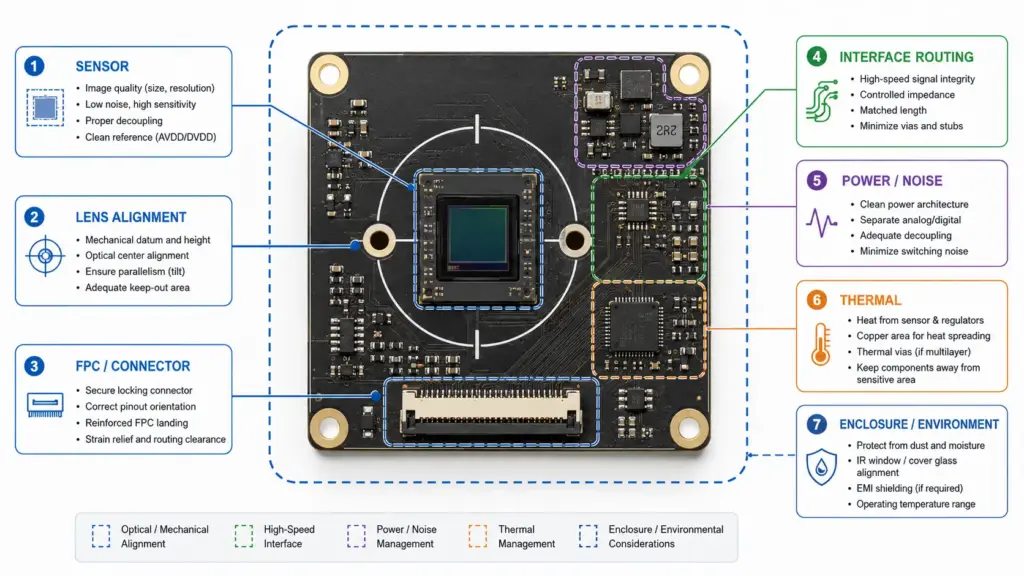
These factors do not guarantee a result by themselves. They help the buyer and supplier review whether the project scope is clear enough for quotation, sampling, and validation.
What to prepare before asking for a quotation
A vague RFQ usually slows down the quotation process. A clearer RFQ helps the supplier understand whether the inquiry is about bare PCB production, PCB assembly, FPC/rigid-flex support, or full camera module manufacturing.
Your RFQ does not need to be perfect. Many early-stage buyers do not have every drawing, file, or test requirement ready. The important thing is to separate what is confirmed from what is still open.
For example, “We need a camera module PCB” is too broad. A more useful inquiry says: “We are developing a compact camera module for an industrial device. We need review of board/module size, interface, connector/FPC layout, sensor target, lens requirement, sample quantity, and test-document needs. Drawings are available, but the final BOM is still under review.”
Camera module PCB RFQ checklist
Prepare as many of these items as possible before asking for a quotation:
- Application or product type.
- Operating environment and installation conditions.
- Camera interface requirement, such as MIPI, LVDS, USB, DVP, GMSL, FPD-Link, or another interface if known.
- Sensor or module target, if already selected.
- Lens, focus, FOV, or optical requirement if relevant.
- Board or module dimensions.
- Connector, cable, FPC, or rigid-flex requirement.
- Enclosure, mounting, or mechanical constraints.
- Gerber files, BOM, drawings, samples, or reference modules if available.
- Expected quantity range, including sample and later production expectations.
- Destination country or region for delivery discussion.
- Testing, inspection, certificate, or document requirements.
- Schedule expectation, clearly marked as a request rather than an assumed lead time.
- Known project risks, such as size limits, high-speed interface concerns, heat, vibration, moisture, or special assembly needs.
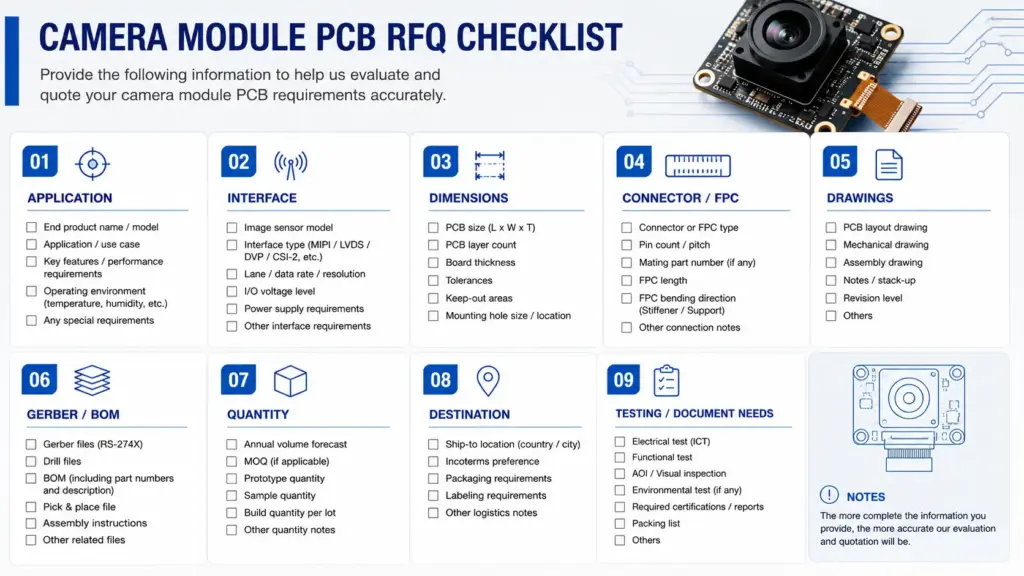
Avoid asking for a fixed price or lead time without sending enough technical information. Price, timeline, MOQ, and feasibility usually depend on project scope, sample review, component availability, documentation needs, quantity, and the supplier’s current production schedule.
What evidence should you request from a supplier?
Supplier pages often use strong words: high quality, fast delivery, certified, advanced, one-stop, or reliable. Those words are not enough for a technical sourcing decision. A better approach is to ask what evidence is available for your exact product, project stage, and target market.
Evidence does not always need to be complex. For an early sample project, the most useful evidence may be a clear scope review, drawing feedback, sample process explanation, inspection plan, and communication path. For a regulated or document-heavy project, the buyer may need certificate scope, test reports, traceability records, or other documents.
The key point is that documents should match the claim. A general website claim does not automatically prove that a specific module, interface, application, or market requirement is covered.
Supplier evidence checklist
| Claim type | What to request | Why it matters | Use caution if missing |
|---|---|---|---|
| Capability scope | Confirmation of whether the supplier is reviewing bare PCB, PCBA, FPC/rigid-flex, full module work, or only part of the project | Prevents scope mismatch before quotation | The supplier uses broad labels but does not clarify what work is included |
| Sample process | Sample review steps, input files needed, feedback loop, and acceptance discussion | Helps engineering plan development work | The supplier quotes without asking enough project details |
| Inspection or testing | Relevant inspection method, sample test plan, or report type if applicable | Helps buyers understand how quality is checked | Claims are made without explaining inspection or validation scope |
| Certification or compliance | Certificates or compliance documents tied to the exact product, process, or target market if required | Avoids assuming a certificate applies to your use case | “Certified” is stated without scope, certificate file, or applicable product details |
| Quality records | Inspection records, sample records, or traceability documents when relevant | Supports production-readiness review | Quality claims remain marketing-level only |
| Component or material sourcing | BOM responsibility, approved alternatives, sourcing limits, or buyer-supplied components | Prevents quotation and schedule surprises | Supplier does not clarify who controls parts and substitutions |
| Commercial terms | Confirmed quotation scope, quantity basis, payment terms, delivery terms, and warranty terms if applicable | Keeps procurement comparison fair | Price, MOQ, lead time, or warranty is assumed from general website text |
| Communication path | Sales, engineering, quotation, and project-contact responsibility | Helps avoid unclear handoff during development | The buyer cannot identify who handles technical questions |
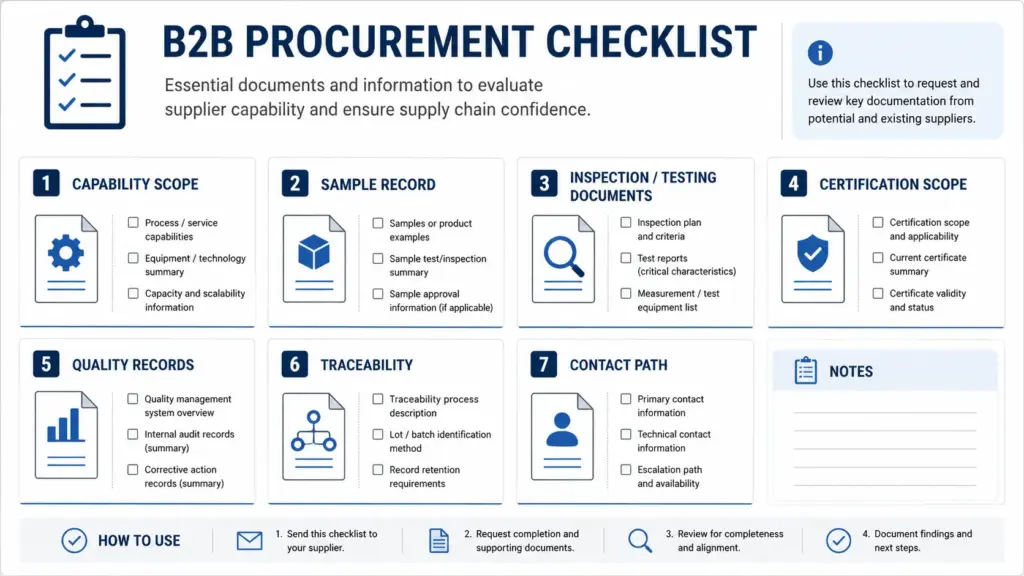
This checklist is not meant to reject a supplier automatically. It helps buyers know which claims require proof, which questions need follow-up, and which details should remain pending until confirmed.
How to compare supplier pages without relying on marketing claims
When comparing supplier pages, do not choose only by broad wording, directory snippets, or the lowest displayed price. For camera module PCB projects, the practical comparison should focus on whether the supplier can review the exact work scope and risk.
Use this comparison framework:
1. Scope fit
Does the supplier clearly match your project need? A bare PCB supplier may be suitable for a finished PCB design. A PCBA partner may be better if you need component mounting. An FPC or rigid-flex supplier may be needed for compact module interconnects. A full camera module manufacturer may be relevant if your project involves sensor, lens, PCB, cable, housing, and sample validation discussion.
2. Technical review quality
Does the supplier ask useful engineering questions? For camera module PCB work, good early questions often involve interface, dimensions, connector or FPC needs, power and noise concerns, thermal conditions, operating environment, and available files.
3. Document clarity
Does the supplier explain what documents are available, what documents are project-specific, and what must be confirmed? Be careful when a supplier mentions certifications or quality systems without showing scope or explaining which product or process they apply to.
4. Sampling and validation path
Does the supplier explain how sample review works before production discussion? Camera module PCB and module projects often need iteration, especially when size, interface, lens position, or connector layout is still changing.
5. Commercial confirmation
Does the supplier separate confirmed quotation details from estimates? Price, lead time, MOQ, warranty, and delivery should be confirmed against the actual project, not assumed from general page text.
6. Communication flow
A useful sourcing conversation is not just “send inquiry.” It should clarify what to send, who reviews it, and what happens next.
When to move from research to supplier contact
You are ready to contact a supplier when your team can describe the project scope clearly enough for review.
That does not mean every file must be finished. It means you can explain what is known, what is open, and what decision you need help with. For example, you may know the application and interface, but still be deciding on the lens or connector. Or you may have a reference module and enclosure constraint, but not a final BOM.
At that point, supplier contact is useful because the supplier can identify missing files, clarify whether the request fits their scope, and suggest what should be reviewed before quotation.
For a Supertek inquiry, use the Camera Module Manufacturing or Camera Module Customization page as context, then send the project details through the contact path. Keep commercial items such as timeline, MOQ, certificates, capacity, warranty, and delivery expectations project-specific until Supertek confirms them for the exact request.
FAQ: Camera module PCB manufacturer questions
What does a camera module PCB manufacturer do?
A camera module PCB manufacturer may provide bare PCB fabrication, PCB assembly, FPC or rigid-flex PCB support, or broader camera module manufacturing support, depending on the supplier. The scope should be confirmed before RFQ because different suppliers handle different parts of the project.
Do I need bare PCB, PCBA, FPC/rigid-flex, or full camera module manufacturing?
Choose based on what your team needs. If you only need a board made from finished Gerber files, a bare PCB supplier may be enough. If components must be mounted, PCBA support may be needed. If the camera must fit in a compact space or connect through a flexible tail, FPC or rigid-flex review may matter. If you need support around sensor, lens, PCB, connector, cable, housing, and validation, a full camera module manufacturing partner may be more relevant.
What information should I send before asking for a quotation?
Send the application, interface, sensor or module target if known, board or module dimensions, connector or FPC requirements, drawings or Gerber/BOM if available, sample needs, quantity range, destination, and any testing or document requirements. If some details are not final, mark them as pending instead of leaving them unclear.
Which PCB type is used in camera modules?
Camera modules may use rigid PCB, HDI PCB, FPC, or rigid-flex structures depending on size, interface, routing density, mechanical constraints, and assembly needs. There is no universal best PCB type. The right option depends on the project’s electrical, mechanical, and validation requirements.
What technical details affect camera module PCB integration?
Important details include interface type, signal routing, connector or FPC layout, board size, sensor and lens position, power behavior, EMI or noise concerns, thermal conditions, enclosure fit, operating environment, and validation needs. These should be discussed before sampling when they affect the project.
What documents should I request from a camera module PCB supplier?
Ask for documents that match your exact project. Depending on the requirement, this may include scope confirmation, sample process notes, inspection or testing documents, certificate scope if applicable, quality records, material or component traceability, and quotation-scope confirmation. Do not assume a general website statement applies to your exact product.
Can camera module PCBs support MIPI, LVDS, or USB?
They may support different interfaces depending on the design, stack-up, routing, connectors, components, and validation process. Interface support should be confirmed against the actual project files and application conditions. Do not treat interface names alone as proof of performance.
How much does a camera module PCB cost?
Cost depends on the project scope. Common drivers include PCB type, layer count, HDI or flexible structure, material requirements, component needs, assembly work, testing, sample quantity, production quantity, documentation needs, and delivery requirements. Exact pricing should be confirmed through RFQ after the supplier reviews the project details.
How long does camera module PCB manufacturing take?
Timeline depends on the design status, supplier scope, sample review, component availability, assembly complexity, testing requirements, document needs, quantity, and current production schedule. Avoid relying on a general lead-time claim until the supplier confirms the project-specific scope.
What certifications should a supplier have?
The needed documents depend on the product, target market, application, and customer requirements. Instead of assuming a certificate is required or applicable, ask the supplier what certificates or compliance documents are available for the exact module, process, and market you are discussing.
Final CTA: Send project details for review
If you are preparing a camera module PCB or camera module manufacturing project, organize the key details before contacting a supplier.
Share the application, interface, sensor or module target, lens or FOV needs, board or module dimensions, connector or FPC requirements, drawings or Gerber/BOM if available, quantity range, destination, sample needs, and testing or document requirements.
With those details prepared, send them to Supertek for a project-scope discussion. For early projects, separate confirmed requirements from open questions so the review can start from a clear technical baseline.