Choosing a camera module manufacturer is not only about finding a supplier list. For OEM, embedded vision, industrial device, smart terminal, robotics, access control, or inspection-related projects, the better question is: can the manufacturer understand your application, match the right module path, and support the project from sample review to production decision?
A camera module that looks suitable on a catalog page may still fail in the real system if the interface, lens, board size, cable, output format, software environment, or lighting condition is not checked early.
This guide explains how to evaluate a camera module manufacturer before sending an RFQ.
How Do You Choose a Camera Module Manufacturer?
Choose a camera module manufacturer by starting with your application requirements, not only the supplier’s product list. Check interface fit, sensor and lens needs, board size limits, host system compatibility, software/output format, documentation, customization support, and sample validation steps. Before requesting a quote, prepare enough technical details so the manufacturer can review the project with fewer assumptions.
Start With the Application, Not the Supplier List
A supplier list can help you find options, but it does not tell you whether a manufacturer fits your project.
Before comparing camera module manufacturers, define the conditions the module must work under. This helps you avoid choosing based only on resolution, price, or broad marketing claims.
Start with these questions:
- What is the application?
- What does the camera need to detect, capture, measure, or monitor?
- What is the target resolution and frame rate?
- What is the working distance?
- What field of view is required?
- What lighting condition will the camera face?
- Does the module need fixed focus or autofocus?
- What host platform will receive the image data?
- Which interface can the host support?
- Are there board size, cable, connector, or enclosure limits?
- What software, driver, OS, or output format is required?
- Will the project need a standard module, modified module, or custom design?
A manufacturer can give better feedback when these details are clear. Without them, the discussion often stays too general: “Do you have a camera module?” or “Can you make this resolution?” That is usually not enough for OEM selection.
How to Evaluate a Camera Module Manufacturer
A good evaluation process compares the manufacturer against your project requirements. The table below can be used as a practical supplier review checklist.
| Evaluation Area | Why It Matters | What to Ask | Evidence Needed |
|---|---|---|---|
| Application fit | The same module may behave differently across lighting, distance, movement, and enclosure conditions. | Have you supported similar application requirements? What conditions should be checked first? | Application notes, sample review process, engineering feedback. |
| Interface support | Interface affects host compatibility, bandwidth, cable design, and integration effort. | Which interface path fits this host system? USB, MIPI, or another option? | Datasheet, interface notes, host compatibility discussion. |
| Sensor and image requirements | Sensor, resolution, frame rate, shutter type, and low-light behavior affect the final image result. | Which sensor path fits the target image result and lighting condition? | Datasheet, sample images if available, test notes. |
| Lens and field of view | Lens/FOV must match working distance, object size, enclosure, and image target. | What lens/FOV options should be checked? | Lens spec, FOV calculation, sample validation. |
| Mechanical design | Board size, connector, cable, and mounting affect whether the module fits the device. | Can the board, connector, cable, or mounting be adjusted? | Drawings, mechanical review, sample fit check. |
| Software and output format | Integration depends on OS, drivers, UVC behavior, SDK needs, and application software. | What output formats and software conditions should be confirmed? | Software notes, driver/SDK notes if applicable. |
| Documentation | OEM buyers often need drawings, datasheets, change control, and test information. | What documents can be provided for evaluation? | Datasheet, drawings, test notes, revision notes. |
| Sample and validation path | A module should be tested before production decisions. | What should be tested at sample stage? | Sample plan, test checklist, engineering feedback. |
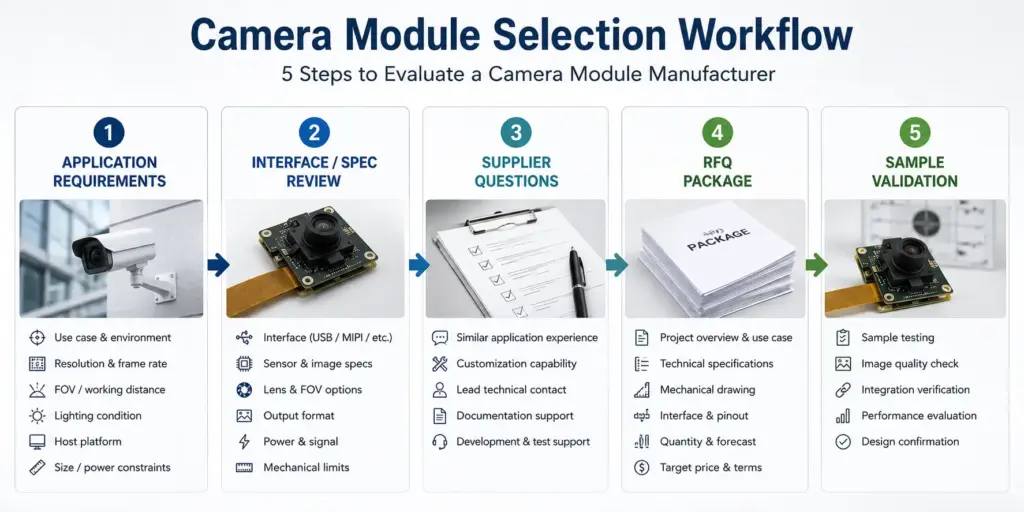
This approach is more useful than asking which supplier is “best.” The right manufacturer depends on the application, technical constraints, and evidence you need before production.
Choose the Interface Around the Host System
Interface choice is one of the first technical decisions. It affects integration work, bandwidth, cable path, software, and host compatibility.
USB and MIPI are common camera module paths, but they are not interchangeable. Long-distance or serializer-based camera paths may also be considered in projects where cable distance, noise, or system architecture makes a direct short cable connection difficult.
| Interface Path | Typical Fit | Host / Integration Checks | Risk to Confirm |
|---|---|---|---|
| USB camera module | Projects needing easier connection to many host systems, especially where UVC behavior may be useful. | OS version, UVC behavior, output format, cable length, bandwidth, application software. | Do not assume every USB module works automatically on every host. |
| MIPI camera module | Embedded systems where the camera connects closely to a processor or embedded board. | Host processor, MIPI lanes, driver support, board layout, software stack. | Integration is more host-specific than a simple plug-in connection. |
| GMSL / FPD-Link-style path | Projects where the camera may need longer cable distance or a system-level serializer/deserializer architecture. | Cable distance, connector, serializer/deserializer design, host board support, EMC/environment needs. | Requires system-level review; not just a module choice. |
| Other custom path | Projects with special mechanical, imaging, or platform constraints. | Electrical design, firmware/software, enclosure, validation plan. | Customization may affect cost, schedule, and validation scope. |
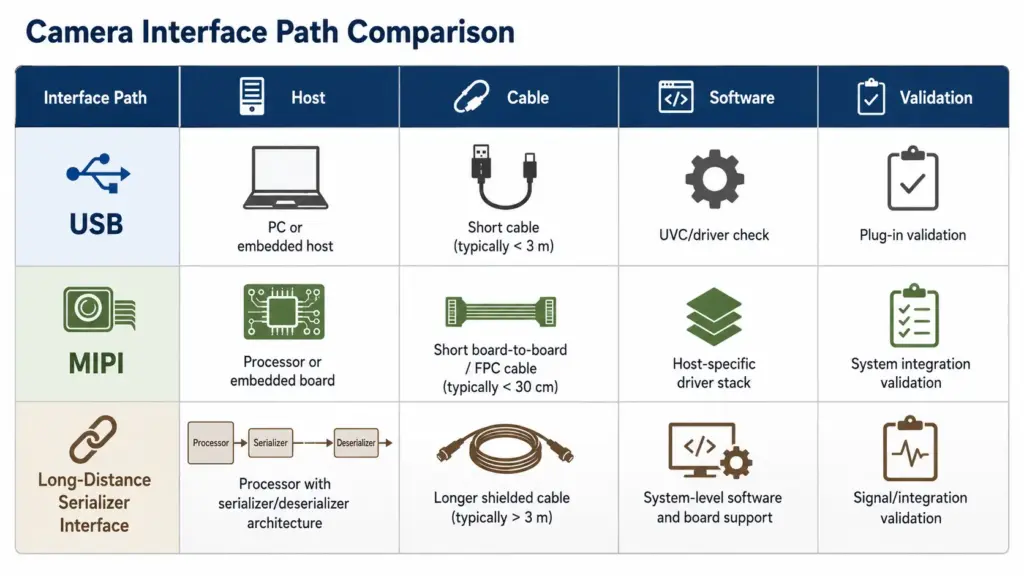
USB Camera Modules
USB camera modules are often considered when a project needs a practical connection path to a host device. For some projects, UVC behavior may reduce driver development work, but it should still be confirmed against the exact operating system, host hardware, output format, frame rate, and application software.
For USB projects, confirm:
- USB version and bandwidth needs
- Target resolution and frame rate
- Output format
- UVC behavior, if required
- Cable length and connector type
- Host OS and application software
- Power and mechanical constraints
- Whether the module is standard, modified, or custom
Do not select USB only because it seems easier. A high-resolution or high-frame-rate module still needs bandwidth, cable, and software review.
MIPI Camera Modules
MIPI camera modules are common in embedded camera designs, especially where the camera connects to a processor or embedded platform. MIPI can be a strong fit for compact embedded systems, but integration depends on the host platform, driver support, lane configuration, board layout, and software stack.
For MIPI projects, confirm:
- Host processor or platform
- MIPI CSI-2 support
- Required lane count
- Sensor compatibility
- Driver availability
- Board-to-board connection
- Mechanical space
- Software integration scope
MIPI selection should be handled as a system integration decision, not only a module purchase.
Long-Distance or Serializer-Based Camera Paths
Some projects need the camera to sit farther from the processing board. In those cases, a long-distance camera interface path may be considered. The decision depends on cable distance, signal integrity, connector design, environment, and host-side architecture.
This type of project should be reviewed early because the interface path can affect module design, cable selection, system cost, and validation work.
Check Sensor, Lens, Mechanical, and Software Requirements
A camera module manufacturer should help you review more than the interface. The image result also depends on sensor selection, lens/FOV, lighting, mechanical fit, and software behavior.
Sensor and Resolution
Higher resolution is not always the right answer. It can increase bandwidth, processing load, storage needs, and low-light challenges. Frame rate also matters if the object moves or if the system needs real-time image processing.
Ask:
- What resolution is actually needed?
- What frame rate is required?
- Is motion involved?
- Is rolling shutter acceptable, or is global shutter needed?
- What lighting conditions will the sensor face?
- Does the system need low-light performance, WDR, or IR sensitivity?
Lens and Field of View
Lens selection affects what the camera can see, how much detail it captures, and whether the image matches the application. The same sensor can produce different results with different lenses.
Prepare:
- Working distance
- Required field of view
- Object size
- Focus distance
- Depth of field needs
- Distortion limits
- Enclosure window or cover lens information
If the lens is not checked early, the sample may capture an image but still fail the real application.
Mechanical Fit
Mechanical details often decide whether a module can be used in a product. A board that is too large, a connector in the wrong place, or a cable that cannot bend inside the enclosure can delay a project.
Confirm:
- PCB size limit
- Mounting hole position
- Connector type
- Cable length and direction
- Enclosure constraints
- Heat and airflow conditions
- Whether drawings are available for review
Software and Output Format
Software requirements can be as important as hardware. A camera module may need to work with a specific operating system, application, processor, driver, SDK, or image format.
Confirm:
- Host OS
- Driver needs
- UVC requirement
- Output format
- Frame rate at the required resolution
- Image control needs
- Firmware or tuning requirements
- Whether the application can accept the image stream
What to Send Before Requesting a Quote
A clear RFQ helps the manufacturer understand your project and reduces back-and-forth. It also helps procurement avoid quotes based on incomplete assumptions.
Before contacting a camera module manufacturer, prepare as many of these details as possible:
| RFQ Item | What to Provide |
|---|---|
| Application | Device type, use case, image target, operating environment. |
| Target resolution | Required resolution or acceptable range. |
| Frame rate | Required FPS at target resolution. |
| Interface | USB, MIPI, GMSL/FPD-Link-style path, or host platform details if unsure. |
| Sensor preference | Preferred sensor if already selected, or image requirement if not. |
| Lens / FOV | Working distance, object size, field of view, focus needs. |
| Lighting condition | Indoor, outdoor, low light, IR, high contrast, moving object. |
| Mechanical limits | PCB size, mounting, connector, cable direction, enclosure limits. |
| Host system | Processor, embedded board, PC, operating system, software environment. |
| Output format | MJPEG, YUY2, RAW, H.264, or other format if required. |
| Quantity range | Sample quantity and expected order range if known. |
| Documentation needs | Datasheet, drawings, test notes, compliance documents if required. |
| Customization needs | Cable, connector, lens, PCB shape, firmware, enclosure, or image tuning. |
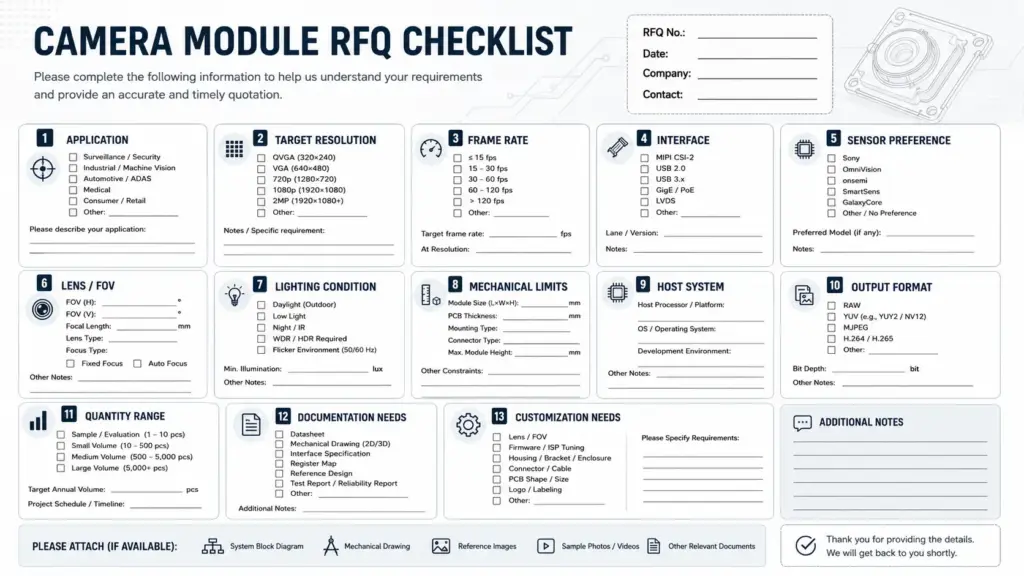
You do not need to know every detail before contacting a manufacturer. But the more complete the RFQ is, the easier it is for the engineering team to suggest a realistic path.
What Documents and Evidence Should You Ask For?
Supplier evaluation should include evidence. This does not mean every project needs the same documents. The right document set depends on application, market, risk level, and procurement process.
Ask what is available for your project type:
- Product datasheet
- Mechanical drawing
- Interface notes
- Lens or FOV information
- Sample test notes
- Image format or software notes
- Revision or change-control information
- Packaging information if relevant
- Compliance documents if required by the target market or application
- Production or quality documents if required by procurement
Be careful with broad claims such as “certified,” “industrial grade,” “medical grade,” or “automotive grade.” These terms may require exact documents, standards, test reports, or approval scope. If your application has compliance requirements, confirm them directly with the supplier and your internal compliance team.
From Sample Review to Production Decision
A sample is not the end of selection. It is the start of validation.
Before moving from sample review to a production decision, check the module under conditions close to the real application.
| Validation Area | What to Check |
|---|---|
| Image result | Resolution, sharpness, color, noise, exposure, distortion. |
| Lighting condition | Bright light, low light, backlight, IR, changing light. |
| Motion | Blur, frame rate, rolling/global shutter needs. |
| Host compatibility | OS, driver, UVC behavior if needed, software stream stability. |
| Mechanical fit | PCB size, mounting, connector, cable direction, enclosure fit. |
| Thermal/environment | Heat, airflow, vibration, dust, humidity, or other project conditions. |
| Cable and connector | Signal stability, bending, length, assembly path. |
| Documentation | Drawings, datasheets, revision notes, test records if available. |
| Production readiness | Confirm final spec, sample approval, packaging, inspection needs, and change-control process. |
The goal is not only to see whether the sample works once. The goal is to reduce risk before committing to a design, purchase order, or production plan.
When to Contact Supertek
If you are evaluating a camera module manufacturer for an OEM or custom project, Supertek’s site describes camera module categories such as USB, MIPI, GMSL, FPDLink, web camera modules, and custom camera module services.
A useful inquiry should include your application, target resolution and frame rate, lens/FOV needs, working distance, lighting condition, board size limits, cable or connector needs, host system, software environment, quantity range, and document requirements.
Supertek can review a suitable camera module path based on the project information you provide.
For a more useful first discussion, prepare:
- Application and device type
- Target image result
- Interface or host system
- Mechanical limits
- Lens/FOV requirements
- Software/output format needs
- Sample and quantity expectations
- Required documents or compliance questions
Contact Supertek with your project requirements, or review Supertek’s camera module categories and custom camera module options before sending an RFQ.
FAQ
How do I choose a camera module manufacturer?
Choose a camera module manufacturer by checking whether the supplier can support your application, interface, sensor, lens, mechanical, software, documentation, and RFQ needs. Avoid choosing only from a supplier list. A manufacturer should be evaluated against your host system, image requirements, validation process, and evidence needs.
What information should I send before requesting a quote?
Send the application, target resolution, frame rate, interface or host system, lens/FOV needs, working distance, lighting condition, PCB size limit, cable/connector needs, operating system, output format, sample quantity, expected quantity range, and document requirements. If you need customization, include drawings or reference samples when available.
What is the difference between USB and MIPI camera modules?
USB camera modules are often used where a more direct host connection is needed, and UVC behavior may be useful in some systems. MIPI camera modules are commonly used in embedded designs where the camera connects closely to a processor or embedded board. The right choice depends on host platform, bandwidth, cable path, software, and validation needs.
Can a camera module be customized for my application?
A camera module may be customized in areas such as lens, cable, connector, PCB shape, firmware, output format, or image tuning, depending on the project requirements and feasibility review. Customization should be discussed with application details, mechanical limits, host system, and validation needs.
What documents should I ask a camera module supplier for?
Ask what documents are available for your project type. Useful documents may include datasheets, mechanical drawings, interface notes, sample test notes, software/output notes, revision information, packaging details, and compliance documents if your application requires them. Do not assume every document is available for every module.
Which specs matter most when selecting a camera module?
Important specs include resolution, frame rate, sensor type, shutter type, lens/FOV, working distance, PCB size, interface, connector, cable length, output format, host OS, software requirements, power, and environmental conditions. The most important specs depend on the application.
What should be tested before moving from sample to production?
Test image quality, lighting behavior, host compatibility, software stability, mechanical fit, cable/connector reliability, thermal or environmental conditions, documentation, and final specification approval. Sample testing should match the real application as closely as possible.
Are camera module certifications required?
Certification needs depend on the target market, application, product category, and buyer requirements. Ask the supplier what documents are available, then confirm with your internal compliance team or relevant regulatory specialist. Avoid relying on broad certification claims without exact document scope.