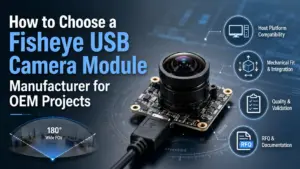
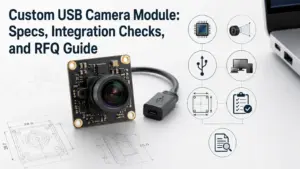
How to Choose a CamerChoosing a camera module manufacturer in China is not just a price search. For custom OEM projects, the better question is whether the supplier can understand your application, match the right camera interface, support the mechanical and optical requirements, and give you enough information to move from evaluation to sample review.
Supertek’s website lists camera module categories such as USB, MIPI, GMSL, FPDLink, web camera, and related module options. Use those categories as sourcing prompts, not as a substitute for project-specific confirmation.
What Matters Most When Choosing a China Camera Module Manufacturer?
Choose a camera module manufacturer in China by checking application fit, host platform compatibility, interface choice, sensor and lens requirements, customization process, documentation transparency, and RFQ readiness. Do not choose only by price, product photos, or broad claims. Ask what the supplier can verify for your exact project before moving to samples or ordering.
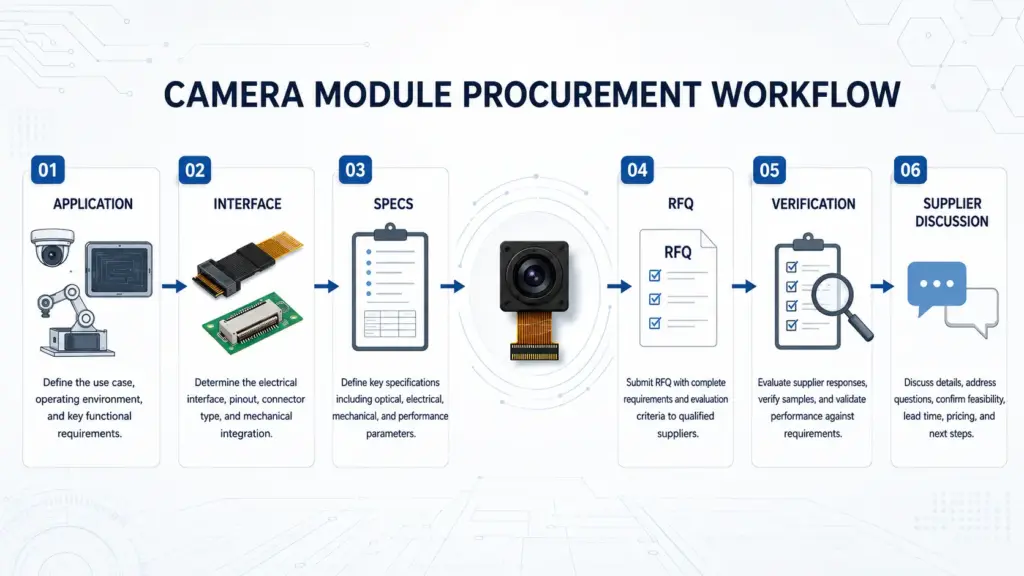
Why Manufacturer Selection Is Different for Custom Camera Modules
A standard camera module may look simple from the outside: sensor, lens, PCB, connector, and cable. In a real product, however, the module has to work inside a system. That system may include a processor board, enclosure, operating system, firmware, lighting conditions, cable routing, thermal constraints, regulatory requirements, and production testing.
This is why a buyer should not evaluate a camera module supplier only by a product photo or a single resolution number. Two modules with the same megapixel count can behave differently if the lens, interface, sensor format, image signal processing, cable length, driver support, or mechanical layout is different.
For OEM buyers, the supplier conversation should start with the application and integration conditions. A good RFQ is not only “send me a 5MP USB camera.” It should explain where the module will be installed, what host platform it connects to, what image output is needed, what mechanical limits apply, and what documents or tests are required before approval.
Supplier Evaluation Checklist for OEM Buyers
Use this checklist before shortlisting a camera module manufacturer. The goal is not to rank suppliers by marketing language. It is to make the first technical conversation more useful.
| Evaluation area | What to check | Why it matters | Safe buyer action |
|---|---|---|---|
| Application fit | Target use case, environment, lighting, enclosure, and operating distance | The same module may not fit every use case | Share real application conditions before asking for a recommendation |
| Interface support | USB, MIPI, GMSL/FPD-Link, DVP, SPI, Wi-Fi, or other interface options | Interface affects host compatibility, bandwidth, cable routing, and software work | Confirm the interface with your processor, board, and OS requirements |
| Sensor and image target | Resolution, frame rate, shutter type, low-light need, HDR/WDR need | Image requirements affect sensor and lens selection | Provide image target and operating conditions, not only megapixels |
| Lens and optics | FOV, focus type, distortion, aperture, IR filter, lens height | Optics often decide whether the module works in the final enclosure | Share FOV, working distance, and mechanical space |
| Mechanical design | PCB size, module shape, connector, cable/FPC length, mounting holes | Small mechanical differences can block installation | Send drawings, enclosure limits, or sample photos when available |
| Software and driver support | UVC, SDK, OS support, host platform, streaming format | Integration risk often appears after the hardware is selected | Ask what has been tested on your target platform |
| Documentation | Datasheet, drawing, test information, certificate availability if required | Procurement and engineering teams need review materials | Ask which documents are available for your project |
| Claim transparency | Lead time, MOQ, warranty, certification, capacity, test process | These are high-risk claims if not verified | Request proof or written terms before relying on them |
Match the Camera Module Interface to Your Host Platform
Interface choice is one of the most important decisions in a custom camera module project. MIPI CSI-2, USB/UVC, GMSL/FPD-Link, and DVP are not interchangeable. Each one brings different integration questions.
MIPI CSI-2 is described by the MIPI Alliance as a camera and imaging protocol used for transmitting image data from image sensors to application processors. That is why host support, lane count, physical layer, driver, and cable design should be checked early.
For USB camera modules, USB-IF’s UVC document set and Microsoft’s UVC driver overview give buyers a practical question to ask: is the module UVC-compliant, and on which operating systems and application environments has it been tested?
For GMSL2-style designs, the project usually needs stronger attention to serializer/deserializer selection, cable type, host input, validation, and layout. Analog Devices describes a GMSL2/1 to CSI-2 deserializer with coax or shielded twisted-pair interconnect context, which supports the general point that GMSL2 projects need system-level review rather than only module-level selection.
| Interface | Often considered when | Key questions to ask | Risk to avoid |
|---|---|---|---|
| MIPI CSI-2 | The camera connects to an embedded processor or SoC with MIPI camera input | Does the host support the sensor, lane count, physical layer, driver, and cable design? | Assuming a MIPI module works with every embedded board |
| USB / UVC | The system needs connection to a computer, embedded board, or USB host | Is the module UVC-compliant? Which OS, format, frame rate, and application environment have been tested? | Assuming “USB” means plug-and-play in every software environment |
| GMSL / GMSL2 | The system team is evaluating serializer/deserializer-based camera architecture or longer cable routing | Which serializer/deserializer, cable, connector, and host input are required? What validation is needed? | Treating GMSL2 as a simple camera cable instead of a system design |
| FPD-Link | The project uses a serializer/deserializer camera architecture | Which chipset, cable, connector, and host receiver are used? | Selecting a module before confirming the host-side design |
| DVP | The project uses a simpler parallel camera interface or legacy platform | Does the host support the data bus, timing, voltage, and driver needs? | Choosing DVP without checking platform support and layout limits |
| SPI / Wi-Fi / Other | The application has special power, distance, or communication needs | What throughput, latency, firmware, and system constraints apply? | Choosing by convenience without checking image and software requirements |
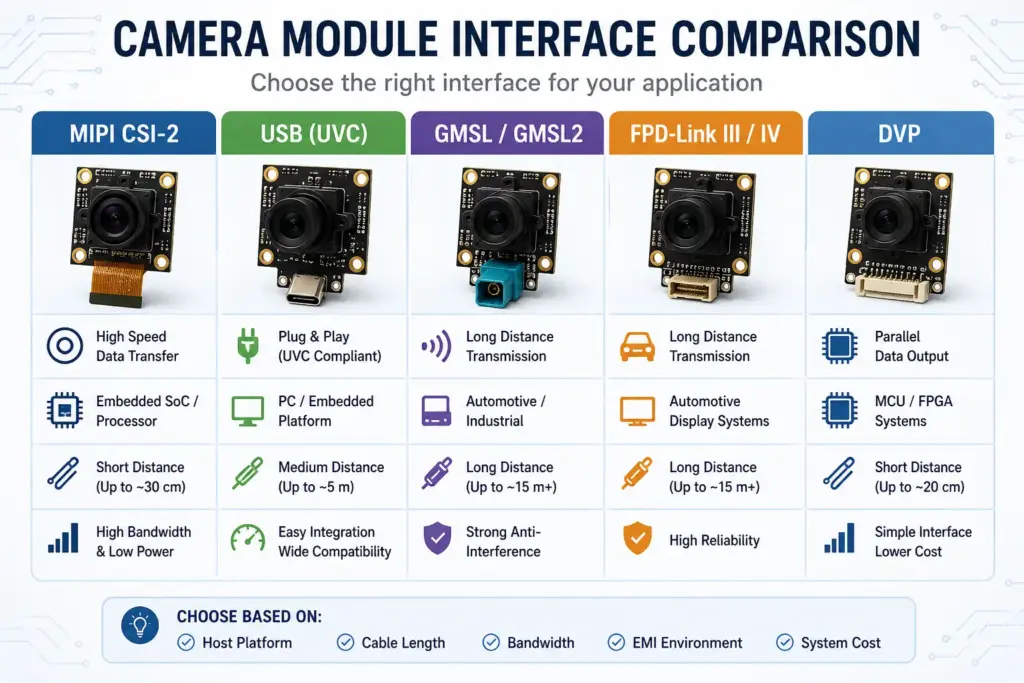
A practical rule: do not ask “Which interface is best?” Ask “Which interface fits my host, cable route, resolution, frame rate, software, and validation plan?”
Specs to Confirm Before Sending an RFQ
A camera module manufacturer can respond more clearly when your RFQ includes technical context. You do not need to know every final detail at the first contact, but you should provide enough information for the supplier to avoid guessing.
| RFQ item | What to prepare | Example buyer note |
|---|---|---|
| Application | Product type and use case | Camera module for industrial inspection inside a compact enclosure |
| Interface | Required or preferred interface | MIPI CSI-2 to existing processor board, or USB UVC preferred |
| Host platform | Processor, board, OS, software environment | Linux embedded board; need driver discussion |
| Image target | Resolution, frame rate, format, low-light or HDR/WDR need | 1080p at target frame rate; indoor lighting |
| Lens and FOV | Field of view, focus type, working distance | Wide FOV, fixed focus, defined object distance |
| Module size | PCB shape, height, mounting holes, enclosure limit | Must fit inside existing housing; drawing available |
| Cable/FPC | Cable length, connector, routing limit | FPC exits from bottom; connector position fixed |
| Special features | IR filter, LED, microphone, waterproofing, global shutter, autofocus | Need IR-cut discussion; no final sensor chosen yet |
| Quantity and stage | Prototype, pilot, mass-production estimate | Prototype evaluation first; annual forecast pending |
| Documents | Datasheet, drawings, test data, certificate needs | Need drawing and datasheet for internal review |
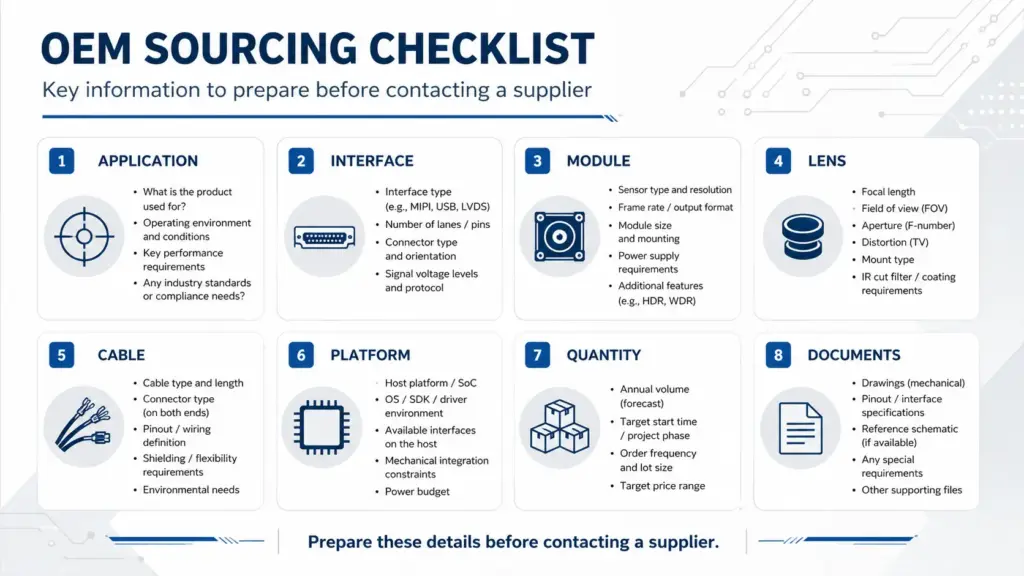
Supertek’s customization page lists interface options such as USB, MIPI, GMSL, FPDLink, SPI, DVP, and Wi-Fi, along with customization-related areas such as pixel range, applications, module dimensions, lens angle, focus, night vision, audio, firmware, PCB size, lens type, cable length, housing, LEDs, connectors, and filters. These items can be used as inquiry prompts, but final capability and terms still need project-specific confirmation.
What to Verify Before Trusting Supplier Claims
Supplier websites often include claims about quality, delivery, MOQ, warranty, production strength, certifications, and application coverage. Some may be true, but high-risk claims should be verified before they affect your purchasing decision.
| Claim type | What to ask for | Why it matters | Draft-safe buyer action |
|---|---|---|---|
| Certification or compliance | Certificate copy, legal entity, scope, validity period | A logo or text claim may not match your product or order | Do not assume compliance; request documents |
| Lead time | Written schedule based on your specs and quantity | Customization changes timing | Treat timing as project-dependent |
| MOQ | Written commercial terms for your module and project stage | MOQ may differ for samples, pilots, and production | Ask for terms after sharing specs |
| Warranty | Written warranty scope and exclusions | Warranty may vary by product and use condition | Request the policy before ordering |
| QC or testing | Inspection items, test conditions, sample approval process | “Quality” is too broad without test criteria | Ask what is tested and documented |
| Capacity | Factory or process evidence if capacity matters | Capacity claims affect supply planning | Verify before committing to repeat orders |
| Application suitability | Requirements, limits, and test needs for your application | Medical, automotive, industrial, or safety-sensitive use may need extra review | Confirm technical and compliance requirements |
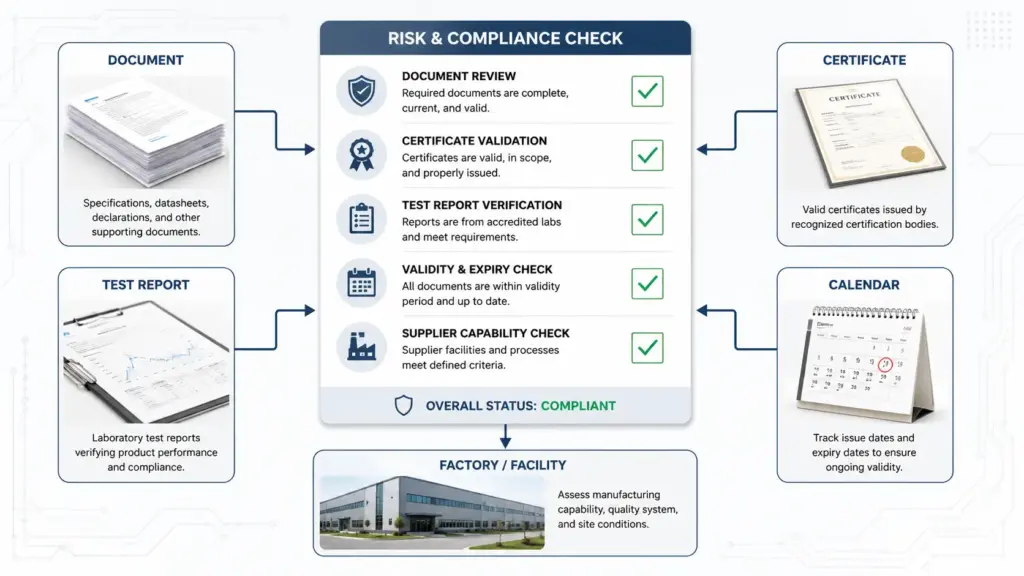
This section is especially important for regulated or safety-sensitive projects. A supplier may list many application categories, but that does not automatically mean a module is approved for every medical, automotive, security, or industrial condition. Treat application pages as starting points for discussion, not final proof.
Application Fit: What Changes by Use Case?
Different applications create different camera module risks. The table below keeps the evaluation practical without assuming universal suitability.
| Application area | Camera module considerations | Questions to confirm |
|---|---|---|
| Industrial inspection | Image consistency, lighting, frame rate, shutter type, lens distortion, mounting stability | What lighting and object speed are expected? Is global shutter needed? |
| Robotics | Interface, cable routing, vibration, synchronization, latency, field of view | How far is the camera from the processor? What latency is acceptable? |
| Automotive or mobility systems | Cable architecture, temperature, vibration, validation, documentation | What standards or validation requirements apply to the project? |
| Medical or healthcare devices | Documentation, image quality, safety or regulatory review, cleaning or enclosure conditions | What compliance review is required before supplier selection? |
| Security or surveillance | Low-light performance, HDR/WDR, lens angle, enclosure, streaming format | What lighting range and recording environment are expected? |
| Wearable or IoT devices | Size, power, thermal limits, wireless or software requirements | What are the battery, space, and firmware constraints? |
| Retail, kiosk, or payment devices | Focus distance, lighting, OS/software integration, long-term availability | What host system and scanning or recognition software will be used? |
The safest sourcing path is to describe the real use condition first, then ask the manufacturer which module architecture can be reviewed for that use.
When to Contact a Camera Module Manufacturer
Contact a manufacturer when you can describe the project well enough for a technical review. You do not need a finished drawing, but you should prepare the core requirements.
- application and product background;
- preferred interface or host platform;
- resolution, frame rate, image format, and sensor preference if known;
- lens, FOV, focus, and working-distance needs;
- PCB/module size, connector, cable, and enclosure constraints;
- operating system, driver, SDK, or software needs;
- prototype, pilot, or production stage;
- expected quantity range if available;
- documents, drawings, testing, or certification needs.
For a Supertek inquiry, point readers toward the most relevant commercial path, such as the customization page or contact page, while avoiding unverified promises about quote speed, sample delivery, MOQ, warranty, or certification.
Planning a Custom Camera Module Project?
Prepare your application, interface, host platform, resolution, lens, module size, cable, software, quantity, and document requirements, then send them for technical review. A clearer RFQ helps the supplier respond with a more relevant camera module recommendation.
Contact Supertek with your project requirements
FAQ
What should I check before choosing a camera module manufacturer in China?
Check technical fit, interface support, customization process, documentation availability, communication quality, sample validation process, and whether important claims can be verified. Do not choose only by price, product photos, or broad marketing statements.
What information should I send for a custom camera module RFQ?
Send the application, host platform, interface, resolution, frame rate, lens and field of view, focus type, module size, cable or FPC, connector, operating system or software environment, expected quantity, project stage, and document requirements. Drawings, enclosure photos, or reference samples can also help.
Which interface should I choose: MIPI, USB, GMSL/FPD-Link, or DVP?
Choose the interface based on host platform, bandwidth, cable route, software support, validation needs, and mechanical constraints. MIPI CSI-2 is common in embedded camera-to-processor designs, USB/UVC may simplify some host connections, and GMSL or FPD-Link style designs usually need serializer/deserializer and system-level validation. Confirm the interface with your engineering team before ordering.
What camera module specs should be confirmed before contacting a manufacturer?
Confirm application, resolution, frame rate, sensor preference, shutter type, lens and field of view, focus distance, module dimensions, connector, cable or FPC length, interface, host platform, operating system or software, lighting condition, and any special requirements such as IR filter, HDR or WDR, global shutter, autofocus, microphone, or waterproofing.
What documents should I ask a camera module supplier for?
Ask what documents are available for your project, such as datasheets, drawings, product specifications, inspection information, test conditions, and certificate copies if compliance matters. Do not assume every supplier can provide every document for every module.
Are MOQ, lead time, warranty, and shipping terms fixed?
No. Treat MOQ, lead time, warranty, shipping, and quotation timing as project-dependent unless the supplier provides written terms for your exact module, quantity, customization level, and destination. These should not be assumed from general website text.
Can a manufacturer help move a prototype camera project into production?
Possibly, but it depends on the supplier’s engineering support, customization process, validation approach, and production readiness. Ask what support is available for drawings, samples, firmware or software discussion, test feedback, and production transfer before relying on that capability.
What software or OS support matters for USB camera modules?
For USB camera modules, ask whether the module is UVC-compliant, which operating systems have been tested, what image formats and frame rates are supported, and whether any SDK, driver, or application-level support is needed. A USB connector alone does not guarantee smooth software integration.