How to Choose an Autofocus Camera Module Manufacturer
Choose an autofocus camera module manufacturer by checking whether the supplier can support your application, interface, sensor and resolution target, focus behavior, optical requirements, mechanical constraints, and validation process. Before requesting samples, prepare your RFQ details and ask what evidence the supplier can provide, such as datasheets, sample images, inspection process information, and available compliance documents.
Why Manufacturer Selection Matters for Autofocus Camera Modules
An autofocus camera module is not only a camera part. In an OEM project, it becomes part of a larger system that may include a processor, enclosure, cable, lens, driver, lighting setup, software stack, and production process. Also, the interface choice, such as MIPI CSI-2 or USB Video Class (UVC), can affect the integration path.
That is why choosing an autofocus camera module manufacturer should not start with price alone. A low-cost module that does not match the host platform, working distance, lighting condition, or mechanical space can delay sample approval. Also, a supplier with a long product list may still need to confirm whether the module can meet your focus, interface, and integration needs.
For buyers and engineers, the better question is not “Which supplier has an autofocus module?” Instead, the better question is: Can this manufacturer help us validate the right autofocus module for our application, integration path, and production plan?
For example, image-quality references such as EMVA 1288 and ISO 12233:2024 can help teams discuss camera performance in a clearer way during sample review.
The sections below provide a practical way to evaluate that question before you send an RFQ or approve samples.
How to Evaluate an Autofocus Camera Module Manufacturer
Start with the project requirement, then work backward to supplier capability. A useful manufacturer evaluation should cover technical fit, project support, evidence, and quotation readiness.
| What to Check | Why It Matters | What to Ask the Supplier | Evidence to Request |
|---|---|---|---|
| Application | Different applications have different focus distance, lighting, speed, and image-quality needs. | What application examples or module types are relevant to this use case? | Application notes, sample images, or similar project references if available |
| Interface | USB, MIPI, DVP, GMSL, FPD-Link, IP, web, or WiFi modules may fit different host systems. | Which interface is suitable for our processor, OS, bandwidth, and mechanical design? | Datasheet, interface notes, driver or platform information |
| Sensor and resolution | Resolution affects image detail, bandwidth, frame rate, and processing load. | Which sensor and resolution options are suitable for our target image quality? | Product datasheet and test images |
| Autofocus behavior | Focus requirements differ for fixed distance, moving objects, variable distance, and software-controlled focus. | Does the module support the focus behavior our application needs? | Module specification and sample testing plan |
| Lens and FOV | Field of view, distortion, depth of field, and working distance affect usable image output. | What lens options or optical constraints should we check? | Lens specification, sample image, optical notes |
| Mechanical fit | PCB size, cable length, connector, housing, and mounting space can affect integration. | Can the module fit our enclosure and connector layout? | Mechanical drawing or 2D/3D files if available |
| Custom/OEM support | Some projects need changes to cable, lens, PCB, firmware, housing, or filter. | What customization scope is available for this project? | Customization checklist and engineering review |
| Inspection and validation | Buyers need to know how samples and production units are checked. | What inspection steps or test records are available? | Inspection process information, test conditions, and quality documents if available |
| Commercial fit | Quantity, sample plan, packaging, and schedule affect sourcing decisions. | What should we confirm before quotation? | Quotation terms, sample plan, and packaging details |
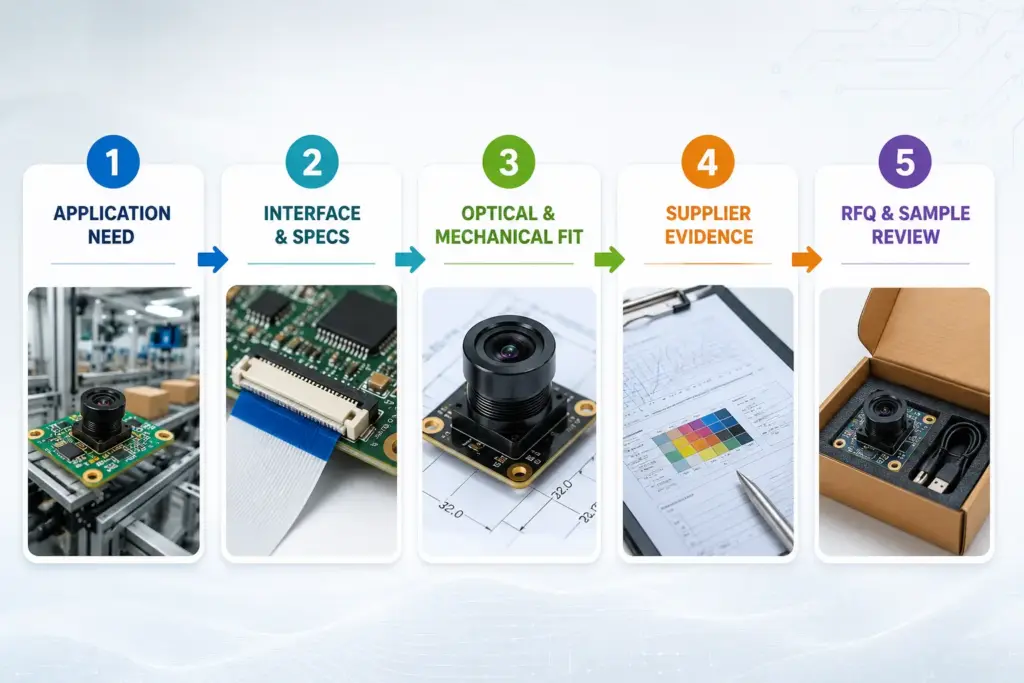
This matrix can also help your team compare multiple suppliers without relying on vague claims such as “high quality” or “fast delivery.”
Match Autofocus Behavior to the Application
Autofocus is useful when the camera must handle changing object distance, variable working conditions, or applications where manual focus adjustment is not practical. But autofocus behavior should still be checked against the use case.
Before choosing a module, confirm these conditions:
- What is the normal working distance?
- Does the object distance change during operation?
- Is the object moving or stationary?
- Is the lighting stable or variable?
- Does the system need continuous autofocus, triggered autofocus, manual focus control, or software focus control?
- What image area must remain sharp?
- Is focus speed, focus stability, or image consistency more important?
- Will the module be used in a compact enclosure, kiosk, scanner, industrial device, regulated or documentation-sensitive equipment, robot, or security product?
Specification alone does not guarantee the right result. The autofocus module should be tested under the expected lighting, distance, target, and host-system conditions before approval.
Choose the Right Interface and Integration Path
Interface choice is one of the most important engineering decisions in camera module sourcing. It affects bandwidth, software integration, cable layout, processor compatibility, power, mechanical design, and testing work.
A supplier may list several interface categories, but your team still needs to confirm which one fits the actual platform. MIPI CSI-2 is a widely used camera and imaging interface for connecting image sensors to application processors, while the USB-IF publishes USB Video Class documentation foar USB video devices. These references are useful context, but they do not replace project-specific module review.
| Interface / Path | Typical Fit | What to Confirm Before RFQ | Risk If Ignored |
|---|---|---|---|
| USB camera module | Projects needing relatively simple connection to computers, embedded systems, kiosks, or devices that support USB video | USB version, UVC support, OS compatibility, cable length, bandwidth, power, enclosure space | Driver or bandwidth mismatch, unstable image output, cable or mechanical issues |
| MIPI camera module | Embedded systems using processors or SoCs with MIPI CSI camera input | Processor support, lane count, driver support, sensor compatibility, cable/connector design | Hardware redesign, driver delays, unavailable image pipeline support |
| DVP camera module | Some embedded platforms or lower-complexity image systems | Processor compatibility, timing, resolution/frame-rate limits | Platform mismatch or limited scalability |
| GMSL / FPD-Link style camera path | Longer-distance or vehicle/industrial-style camera connections where applicable | Serializer/deserializer compatibility, cable, EMI, power, validation requirements | Signal integrity or integration issues |
| IP / web / WiFi camera path | Networked or remote viewing applications where applicable | Latency, compression, power, network stability, security requirements | Latency, quality, or reliability mismatch |
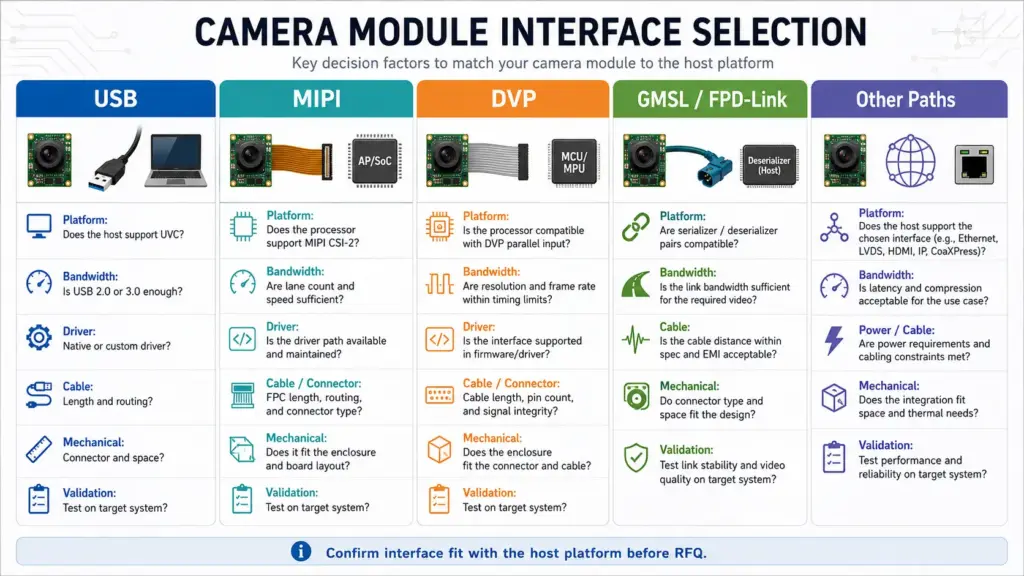
No interface is universally better. USB may simplify some integrations. MIPI may fit compact embedded designs. GMSL or FPD-Link may be considered for longer-distance camera links. The right choice depends on the host system, image pipeline, mechanical layout, production target, and validation resources.
When Custom/OEM Requirements Change the Supplier Evaluation
Many OEM projects cannot use a camera module exactly as listed. The module may need to fit a housing, match a connector, use a specific cable length, support a lens requirement, or work with firmware and software constraints.
Custom requirements may include:
- PCB size or module shape
- Sensor or resolution selection
- Lens type or field of view
- Cable length and connector
- Housing or bracket
- LED or filter requirements
- Firmware or software adjustments
- Mechanical drawing review
- Packaging or labeling requirements
Supertek’s public customization page describes customization options such as module dimensions, hardware, firmware, PCB size, lens type, cable length, housing, LEDs, connectors, and filters. For a specific project, buyers should still confirm feasibility, sample requirements, validation scope, schedule, and quotation terms during the RFQ process.
Customization can be valuable, but it also adds review steps. The more the module changes from a standard option, the more important it becomes to confirm drawings, samples, test conditions, and approval criteria before moving toward production.
What to Prepare Before Requesting a Quote
A clear RFQ helps the supplier respond with a more relevant recommendation. It also reduces back-and-forth communication and prevents the supplier from guessing important conditions.
Prepare the following information before contacting an autofocus camera module manufacturer:
| RFQ Item | What to Provide | Why It Helps |
|---|---|---|
| Application | Device type, use case, operating scenario | Helps the supplier understand image and integration needs |
| Interface | USB, MIPI, DVP, GMSL, FPD-Link, IP, web, WiFi, or unsure | Helps narrow compatible module types |
| Sensor / resolution target | Required resolution, preferred sensor, frame-rate target if known | Helps balance image detail, bandwidth, and processing load |
| Focus distance | Minimum, typical, and maximum working distance | Helps evaluate autofocus behavior and lens options |
| Field of view | Required viewing angle or target scene size | Helps select lens and optical configuration |
| Lighting condition | Indoor, outdoor, low light, variable lighting, LED illumination | Helps assess image quality and focus stability |
| Host platform | Processor, OS, development board, or computer system | Helps check driver and interface compatibility |
| Mechanical constraints | PCB size, connector, cable length, enclosure space, mounting method | Helps evaluate physical fit |
| Quantity | Prototype quantity and expected production range if available | Helps the supplier understand sourcing and production expectations |
| Sample plan | Whether you need evaluation samples, modified samples, or production-intent samples | Helps define the next step |
| Compliance/document needs | Any required documents for your industry or buyer review | Helps the supplier confirm what documents are available |
| Commercial questions | Target schedule, packaging, payment, warranty, or logistics needs | These should be confirmed during quotation, not assumed |
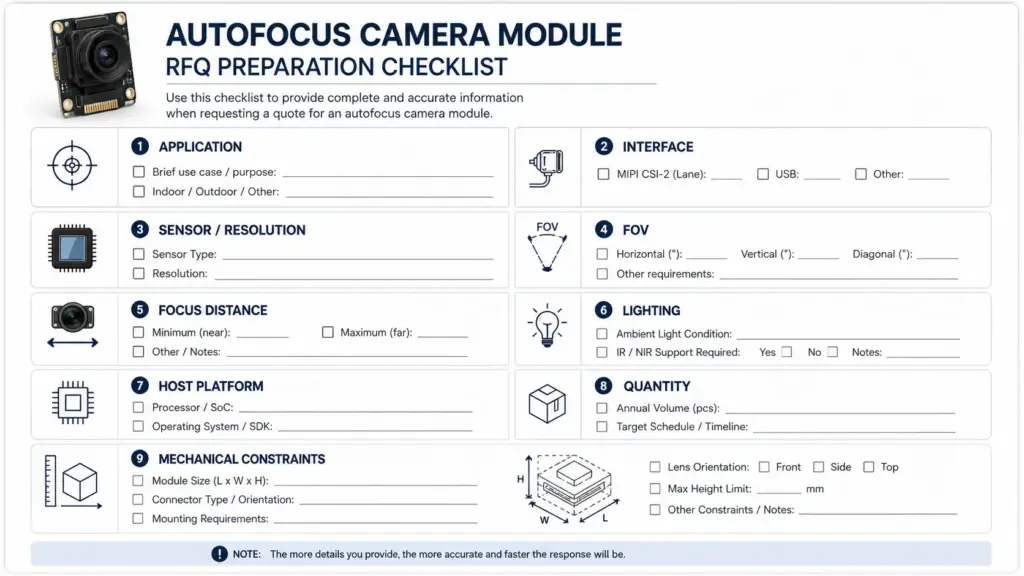
Avoid asking only, “What is your best price?” A better first inquiry includes technical and commercial context, so the manufacturer can check whether the module is suitable before quoting.
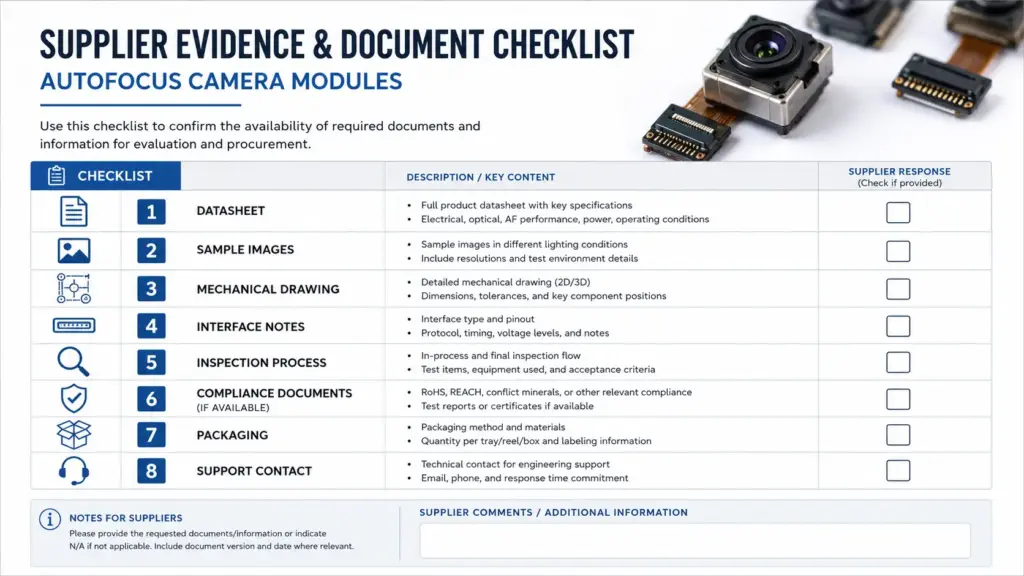
What Evidence Should You Ask a Manufacturer For?
Supplier evaluation should be evidence-based. Instead of relying on broad claims, ask what proof or documentation is available for your project.
| Evidence to Ask For | Why It Matters | Notes |
|---|---|---|
| Product datasheet | Confirms sensor, resolution, interface, size, lens, and electrical details | Required before engineering review |
| Sample images or video | Helps evaluate image quality under relevant conditions | Best when test conditions are explained |
| Mechanical drawing | Confirms PCB, connector, cable, and mounting fit | Important for enclosure design |
| Interface / driver notes | Helps engineering teams check platform compatibility | Especially important for embedded systems |
| Inspection process information | Shows how the supplier describes quality checks | Do not assume guarantees; review the process |
| Compliance or certificate documents if available | May be required by buyer or industry | Ask for exact documents; do not rely on generic claims |
| Packaging information | Helps procurement and logistics planning | Important for repeated orders |
| Change-control or revision notes | Helps production teams manage consistency | Useful for long-term OEM projects |
| Support contact path | Helps clarify engineering questions during sampling | Important before sample approval |
Supertek’s public manufacturing page describes process areas such as PCB design, lens assembly, focusing, SMT, quality inspection, IC programming, and packing. Buyers can use this as a starting point for discussion, but project-specific evidence should still be requested during RFQ and sample review.
Pre-Sample Validation Checklist for Engineers
Before approving an autofocus camera module sample, engineering teams should define how the sample will be tested. This prevents a sample from being accepted based only on a quick visual check.
Use this checklist before or during sample review:
- Confirm host platform compatibility.
- Confirm the interface and connector.
- Confirm driver or software support path.
- Confirm power requirements.
- Confirm mechanical fit inside the device.
- Confirm cable length and routing.
- Confirm field of view and lens suitability.
- Test focus behavior at minimum, normal, and maximum working distance.
- Test under expected lighting conditions.
- Test with the actual object or scene type.
- Check frame rate and image stability.
- Check thermal or enclosure effects if relevant.
- Document sample settings and test conditions.
- Define approval criteria before moving to the next sample or production stage.
For OEM projects, sample validation should involve both engineering and procurement. Engineering confirms fit and function. Procurement confirms documentation, terms, packaging, and supplier communication.
How Supertek Fits Into the Evaluation Process
Supertek lists autofocus camera module options on its autofocus camera module page. Its public pages also organize camera module options by interface and focus type, and describe customization and manufacturing process topics.
For buyers and engineers, these pages can support the evaluation process in three ways:
- Review autofocus module options. Use the autofocus camera module page to see listed module examples and start a product inquiry.
- Discuss custom/OEM requirements. If your project needs changes to dimensions, hardware, firmware, PCB size, lens, cable, housing, LEDs, connectors, or filters, use the customization discussion as part of your RFQ.
- Ask about process and evidence. Use the manufacturing and inspection process information as a starting point for questions about sample review, inspection steps, and available project documents.
The safest approach is to send your application details and ask Supertek to confirm which module option, customization path, and validation process may fit your project. Avoid assuming that any listed module is automatically suitable without technical review.
FAQ
What is an autofocus camera module?
An autofocus camera module is a compact camera module designed to adjust focus automatically or through a supported control method. It usually includes a sensor, lens, PCB, connector, and interface. The exact focus behavior, interface, resolution, and software support depend on the specific module.
What should I compare before choosing an autofocus camera module manufacturer?
Compare application fit, interface, sensor and resolution, autofocus behavior, lens and field of view, mechanical size, customization support, sample validation process, inspection information, and RFQ responsiveness. For OEM projects, also check whether the supplier can provide the documents and technical support your team needs.
What specs should I send for an autofocus camera module RFQ?
Send your application, interface requirement, sensor or resolution target, frame-rate needs, field of view, focus distance, lighting conditions, host platform, operating system, mechanical constraints, connector or cable needs, estimated quantity, sample plan, and any document requirements. This helps the supplier review feasibility more accurately.
Is USB or MIPI better for an autofocus camera module?
Neither USB nor MIPI is always better. USB may be easier for some computer, kiosk, or embedded applications. MIPI is often used in compact embedded systems with processors that support camera input. The right choice depends on host platform, bandwidth, driver support, power, cable design, mechanical space, and validation resources.
Can autofocus camera modules be customized?
Autofocus camera modules may be customizable depending on the supplier, module platform, and project requirement. Common discussion points include PCB size, lens, cable, connector, housing, firmware, filter, and mechanical layout. For a Supertek project, buyers should confirm the exact customization scope during RFQ and sample review.
What documents should I request from a camera module manufacturer?
Ask for product datasheets, mechanical drawings, sample images or video, interface or driver notes, inspection process information, packaging details, and available compliance documents if your project requires them. Do not assume a certificate or document is available unless the supplier confirms it.
What integration risks should engineers check before samples?
Engineers should check host platform compatibility, interface, driver path, power, connector, cable routing, mechanical fit, thermal conditions, focus behavior, lighting conditions, field of view, and image quality test scenes. These checks should be defined before sample approval.
Does autofocus support continuous focus, manual focus, or software focus control?
It depends on the module and control method. Some modules may support specific focus modes or software control, while others may not. Confirm the focus behavior, control options, driver support, and test method with the supplier before choosing a module.
Send Your Autofocus Camera Module Requirements
To evaluate an autofocus camera module for your project, prepare your application details, required interface, sensor or resolution target, focus distance, field of view, lighting conditions, host platform, mechanical constraints, expected quantity, and sample timeline.
Share these details with Supertek so the team can review which autofocus camera module option may fit your application and what should be confirmed before sampling.