Need a camera module that fits your device, image requirements, interface, or enclosure? A standard module may be enough for early testing, but many OEM projects need custom review before sampling, validation, or production planning.
Use this page to prepare a custom camera module inquiry for Supertek review. Share your application conditions, target image result, drawings or sample reference, interface preference, host platform, quantity range, and document needs so the project can be reviewed before quotation or sampling discussion.
When Do You Need a Custom Camera Module?
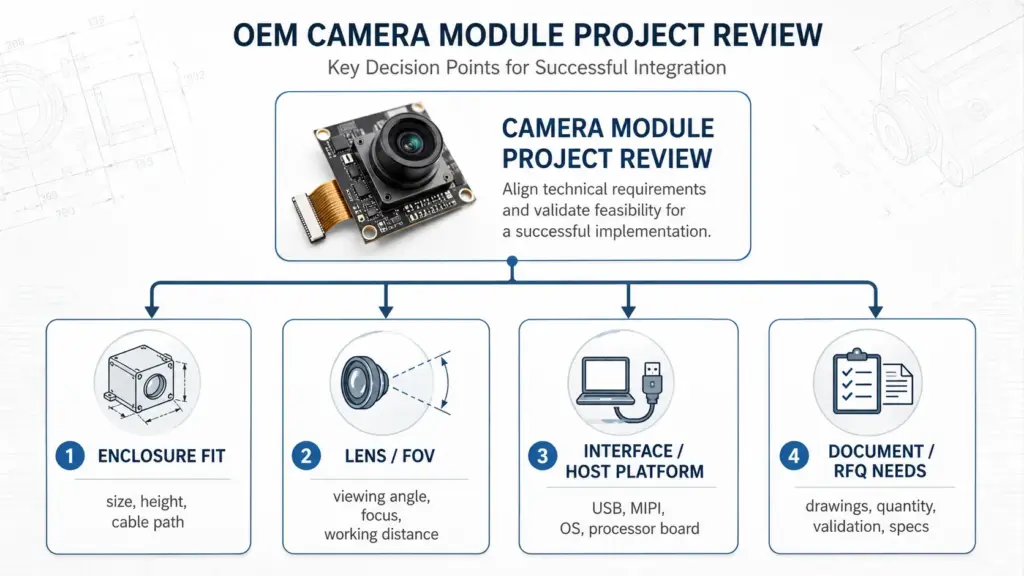
You may need a custom camera module when a standard module does not match your enclosure, lens/FOV, cable, connector, interface, host platform, image output, or project documentation needs. A custom review helps confirm which optical, mechanical, electrical, and platform details must be checked before RFQ, sampling, or production discussion.
What to Prepare Before Requesting a Custom Camera Module
A useful custom camera module inquiry starts with clear project information. Instead of asking only for a price, prepare the details that affect feasibility, module selection, integration, and quotation.
Prepare these items before contacting Supertek:
- Application or device type
- Working environment and lighting conditions
- Target image result or image problem to solve
- Resolution and frame rate requirements
- Lens type, field of view, working distance, or focus requirement
- Module size, PCB/FPC shape, or mechanical drawing
- Interface preference, such as USB, MIPI, GMSL, or FPD-Link
- Cable, connector, and installation constraints
- Host platform, operating system, or processor board
- Quantity range and project stage
- Existing sample, drawing, or reference module
- Required documents or test information to confirm
The clearer the input, the easier it is to review whether a standard platform, modified module, or deeper custom design discussion is needed.
Is a Standard Camera Module Enough, or Do You Need Custom Review?
Not every project needs a custom module. A standard camera module may be enough when the interface, image quality, size, lens, and connector already match your system. Custom review becomes more useful when the camera must fit a defined product structure or pass project-specific integration checks.
| Project Situation | Standard Module May Fit | Custom Review May Be Needed | What to Prepare |
|---|---|---|---|
| Early software or image testing | You only need a working reference camera. | You need the test result to match final product conditions. | Platform, OS, interface, image target |
| Fixed product enclosure | Existing module size fits the space. | PCB/FPC, cable, connector, or lens position must change. | Mechanical drawing, space limit, connector direction |
| Specific viewing angle | Existing lens/FOV is acceptable. | Lens, FOV, focus distance, or distortion must be reviewed. | Lens requirement, working distance, sample image |
| Host platform integration | Standard interface and driver path are enough. | Interface, output format, or platform support needs review. | Main board, processor, OS, interface |
| Procurement planning | Existing module can be ordered as-is. | Documents, revision control, or project-specific requirements must be discussed. | Quantity range, document list, validation needs |
Use this decision path before RFQ: if the standard module fits the device, interface, lens, and validation needs, it may be a suitable starting point. If any of these items are uncertain, prepare the details for custom project review.
Customization Options to Discuss
For broader context, see Supertek’s Camera Module Customization page.
Camera module customization is not only about changing one component. The final module may need review across optical, mechanical, electrical, software/platform, and procurement requirements.
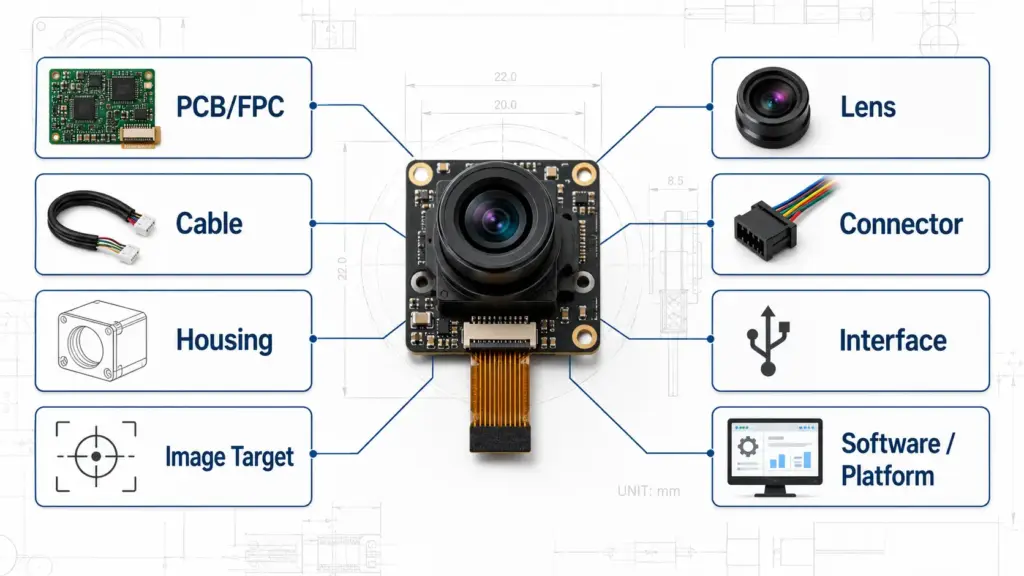
Common discussion areas include PCB or FPC dimensions, lens and field of view, cable and connector, housing, interface, image target, and host platform requirements. Actual customization scope depends on project review, mechanical limits, module platform, and validation needs.
| Review Area | Examples to Discuss | Why It Matters | What to Send |
|---|---|---|---|
| Optical design | Lens, FOV, focus distance, image target | Affects image coverage, clarity, distortion, and working distance. | Target image, working distance, lighting condition |
| Mechanical fit | PCB/FPC size, module height, mounting position | Determines whether the module can fit into the product structure. | Drawing, enclosure space, reference sample |
| Cable and connector | Cable length, connector type, direction, pin needs | Affects installation, assembly, and board connection. | Connector drawing, board layout, assembly constraints |
| Interface | USB, MIPI, GMSL, FPD-Link, or other interface discussion | Affects host connection, bandwidth, platform integration, and cable design. | Host platform, interface preference, processor board |
| Image output | Resolution, frame rate, format, low-light or dynamic-scene needs | Affects sensor/module selection and validation plan. | Image requirement, scene conditions, test target |
| Platform questions | OS, driver path, SDK need, processor board | Helps identify integration risks before sampling. | Platform model, OS, software environment |
| Documents | Drawing, specification, test information, compliance needs | Supports procurement review and internal approval. | Required document list and project stage |
Avoid assuming that every item can be changed in every project. The purpose of the custom inquiry is to review which changes are practical for the project stage, module platform, and application conditions.
Interface and Integration Questions to Confirm
Interface choice affects more than the connector. It can influence cable distance, bandwidth, host platform support, image output, and integration workload. Supertek lists camera module categories by interface such as USB, MIPI, GMSL, and FPD-Link, but the right choice depends on the product system.
| Interface Topic | Useful For | Questions to Confirm | Risk to Avoid |
|---|---|---|---|
| USB camera module | Systems where USB camera integration is preferred | Does the host support the required resolution, frame rate, and format? | Assuming all USB modules behave the same across platforms |
| MIPI camera module | Embedded systems using processor camera interfaces | Does the processor board, OS, and driver path support the sensor/module? | Selecting hardware before checking platform support |
| GMSL camera module | Projects that need serialized camera connection architecture | What distance, cable, connector, and system architecture are required? | Treating interface choice as only a camera-side decision |
| FPD-Link camera module | Systems with serialized camera connection requirements | What serializer/deserializer, cable, and host-side design will be used? | Ignoring system-level compatibility |
| Connector and cable | Any custom installation | What connector direction, cable length, and assembly constraints apply? | Confirming image specs but missing mechanical integration |
For engineering review, send the host platform, operating system, interface preference, expected cable path, connector needs, and target image output. This helps reduce mismatch before sampling.
RFQ Checklist for a Custom Camera Module
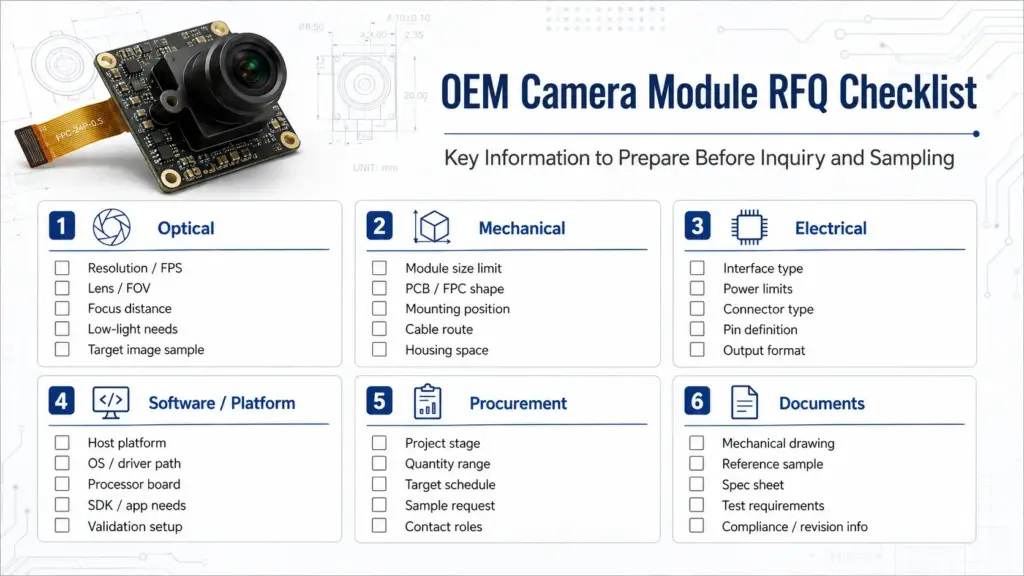
A clear RFQ helps the supplier understand the project faster and avoid repeated clarification. Use this checklist before sending your requirements.
Application and Image Requirements
- What product or device will use the camera?
- What scene will the camera capture?
- What lighting conditions should be considered?
- What image problem are you trying to solve?
- What resolution and frame rate are needed?
- Do you have sample images or target image references?
Optical Requirements
- Required field of view
- Working distance
- Focus type or focus distance
- Lens size or lens space limitation
- Any distortion, low-light, or image consistency concerns
Mechanical Requirements
- Module size limit
- PCB/FPC shape or drawing
- Mounting method
- Cable length and direction
- Connector model or preferred connector
- Product enclosure drawing or reference sample
Electrical and Interface Requirements
- Interface preference
- Host platform or processor board
- Operating system
- Output format
- Power or signal constraints
- Cable and connector pin requirements if known
Procurement and Project Requirements
- Project stage: concept, prototype, validation, or production planning
- Estimated quantity range
- Required documents for internal review
- Target schedule for discussion, without assuming confirmed lead time
- Contact person for engineering and procurement questions
Files to Attach
- Mechanical drawing
- Existing sample photos
- Reference module specification
- Host platform information
- Image target or test scene
- Required document list
What to Confirm Before Sampling or Production Discussion
Before moving from inquiry to sampling or production discussion, confirm the project details that may affect fit, validation, and procurement approval.
| Confirmation Item | Why It Matters | Safe Question to Ask |
|---|---|---|
| Final module specification | Prevents mismatch between inquiry and sample expectation. | Which specification version will be reviewed? |
| Drawing and mechanical fit | Avoids enclosure or connector conflicts. | Can the module drawing and installation direction be confirmed? |
| Interface and platform | Reduces integration risk. | What host platform, OS, and interface details should be checked? |
| Lens and image target | Connects optical choice to real application need. | What image sample or target scene should be used for review? |
| Test conditions | Helps align validation expectations. | What lighting, distance, and operating conditions should be tested? |
| Documents | Supports procurement and internal approval. | What documents or compliance information are available for this project? |
| Revision control | Helps track changes before production discussion. | How will module changes be recorded and confirmed? |
Do not assume that documents, compliance information, timing, or commercial terms are the same for every project. Confirm them based on the module, application, destination market, and order conditions.
FAQ for Custom Camera Module Projects
What is a custom camera module?
A custom camera module is a camera module reviewed or configured around a project’s optical, mechanical, electrical, interface, software/platform, and procurement requirements. The customization discussion may include lens, FOV, PCB/FPC size, cable, connector, interface, image target, and host platform needs.
When should I choose a custom camera module instead of a standard module?
Choose custom review when a standard camera module does not fit your enclosure, lens/FOV, connector, cable, interface, host platform, image result, or documentation requirements. If a standard module already fits your system and validation needs, it may be a suitable starting point.
What information should I send for a custom camera module RFQ?
Send your application, lighting condition, target image result, resolution and frame rate, lens/FOV needs, size limits, interface preference, cable and connector details, host platform, quantity range, drawings or sample references, and document requirements.
What customization items should be discussed before engineering review?
Common discussion items include PCB/FPC dimensions, lens and field of view, cable and connector, housing, interface, image output, host platform, and document needs. Actual scope should be reviewed based on project requirements and module constraints.
How should I choose between USB, MIPI, GMSL, and FPD-Link camera modules?
Start with the host system and application. USB may be useful where USB camera integration is preferred, MIPI is common in embedded processor systems, and GMSL or FPD-Link may be discussed when serialized camera connection is part of the system design. Confirm platform, cable, connector, bandwidth, and validation needs before choosing.
What documents should I ask about before sampling or production?
Ask what specification, drawing, test information, compliance information, and revision records are available for your project. Do not assume every document applies to every camera module; confirm document availability with the supplier before sampling or production discussion.
Send Your Custom Camera Module Requirements
Contact Supertek with your application conditions, target image result, drawings or sample reference, lens/FOV needs, interface preference, host platform, quantity range, and document requirements for project review.
A good RFQ does not need to be perfect. It should give enough information for engineering and sales teams to understand what must be checked before quotation, sampling, or production discussion.